
Livia: “A blight upon the nation as a mother, a blight upon the house of Caesar as a stepmother.” Tacitus Annals 1.10.5
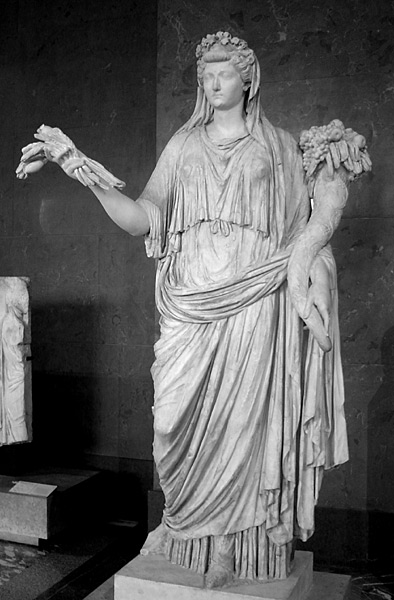
Livia Drusilla (58 BCE–29 CE) was portrayed as the quintessential Roman matrona (mother)—modest, devoted, and virtuous. This image shaped imperial propaganda and earned her an
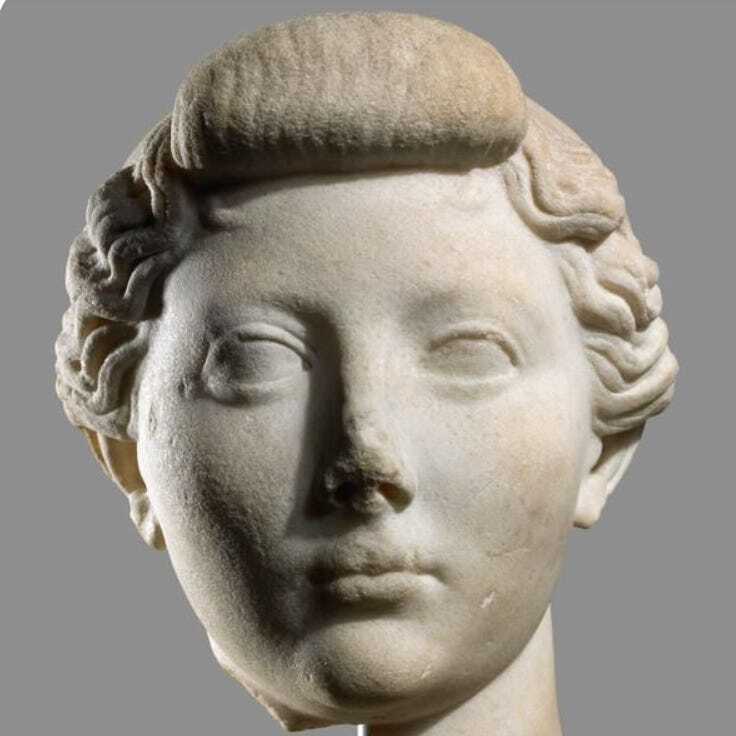
extraordinary amount of public statuary as well as a considerable cult following during her lifetime, particularly in the Greek East, where she was worshipped as a goddess. Moreover, she received unprecedented public honors, including the honorific title Augusta, significant financial independence, and awarded sacrosanctitas (inviolability) with privileges equivalent to those of the highly revered Vestal Virgins.
Considering the numerous accolades she achieved during her significant lifetime, many of her contemporaries might have been surprised to learn that Livia’s sterling reputation has become tarnished over the years. Ancient historians, such as Tacitus, Suetonius, and Cassius Dio depicted Livia as a ruthless, power-hungry schemer, reflecting a common narrative of powerful women in antiquity. But more than that, they also accused her of poisoning potential successors to ensure that her son Tiberius would become emperor.
Indeed, it is regrettable that each time a successor emerged, he eventually met an untimely and tragic end. Was this serendipity merely a coincidence, or could someone have intervened to bring about the demise of these successors? Although it remains impossible to definitively prove or disprove instances of poisoning in antiquity—a challenge that persists even today–perhaps by looking at the series of premature deaths among Augustus’s potential heirs we can separate fact from fiction and understand if Livia had a hand in poisoning any of them as the ancients so assiduously report.
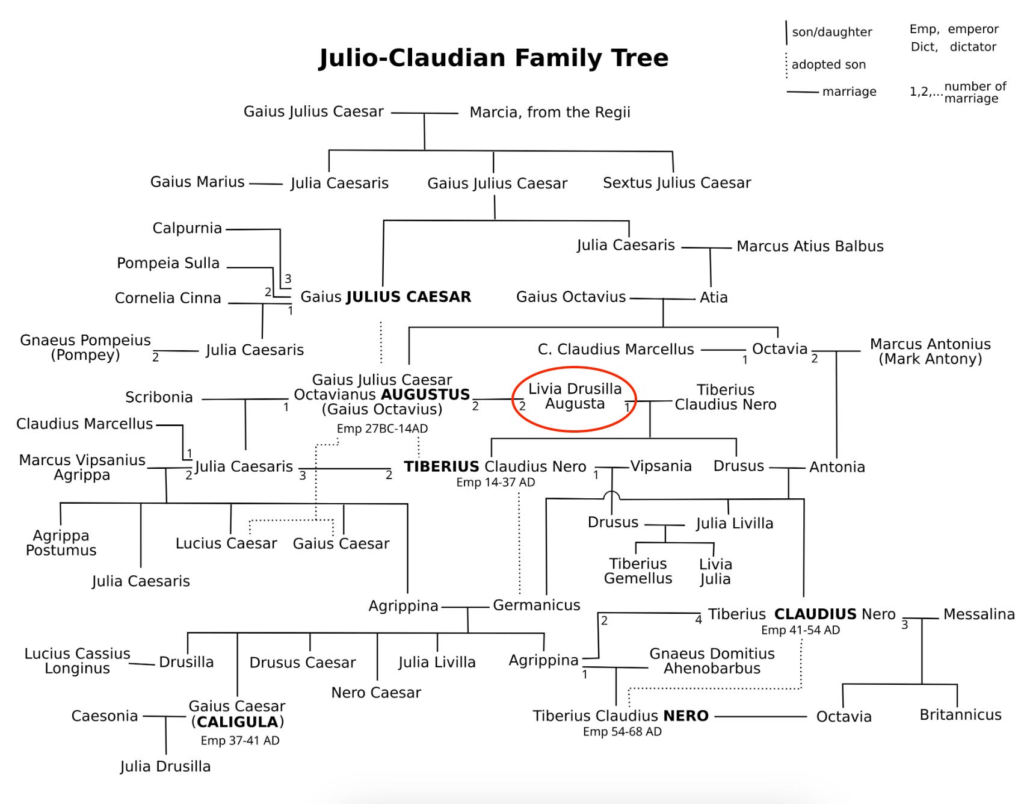
As the third wife of Caesar Augustus, Rome’s first emperor, Livia Drusilla served as a formidable, prudent, and key advisor throughout their fifty-one-year marriage and his forty-year rule. As matriarch of the Julio-Claudian dynasty, she was the mother of Augustus’s successor, Tiberius; the great-grandmother of Tiberius’s successor, Caligula; the grandmother of the fourth Julio-Claudian emperor, Claudius—under whose authority she was deified in 42 CE; and the great-great-grandmother of Emperor Nero, the final emperor of the Julio-Claudian dynasty.
When Augustus transformed succession into a coveted prize, tensions grew between the Julian and Claudian branches of the dynasty. Notably, five of Augustus’s six unsuccessful heirs hailed from the Julian branch of the Julio-Claudian dynasty. It’s important to note, Marcus Agrippa was a Julian by marriage and Germanicus descended from both houses.
The Julio-Claudian’s most prolific ancient chroniclers, Tacitus, Suetonius, and Cassius Dio, wrote anywhere from 100-200 years after Livia died, during the reigns of emperors who were hostile to the Julio-Claudian clan. To write positively about her was possibly to put their lives (or livelihoods) at risk. Moreover, Tacitus sourced material regarding the Julio-Claudian dynasty from the now-lost Memoirs of Agrippina the Younger, which may have offered a biased view of Livia due to the profound hostility between Agrippina the Elder, her mother, and Livia.
Of the three Roman historians, Tacitus most effectively uses the word noverca (stepmother) against Livia. The notion of the evil stepmother was persuasive in Roman society, particularly in its association with the poisoning of stepchildren. This bias against Livia is apparent the first time Tacitus introduces her: “novercae Liviae dolus.” (craftiness of their stepmother, Livia). But the moniker noverca is not the only slander that Livia receives from the hands of the ancients, Cassius Dio even claims that she poisoned the emperor himself to hasten his death and clear the path for Tiberius.
While the Roman chroniclers were among the first to write of her, modern readers may be more familiar with Livia from Robert Graves’s 1934 novel, I, Claudius where he drew upon the accounts of the ancients in his narrative. His depiction of Livia as proficient in the art of poisoning transforms the ancient chroniclers’ rumors and conjectures into the realm of widely accepted theory and fact. Following the book’s adaptation into the 1976 acclaimed BBC mini-series, where Dame Siân Phillips portrayed Graves’ Livia with pitch-perfect skill, many developed an even more distorted image of the empress, one we hope to clarify.
But before embarking on Livia’s alleged poisonings, it’s critical to discuss her origins.
Liva’s Background
Livia was born into the aristocratic Claudii, one of the founding families of the Roman Republic. Even Tacitus begrudgingly notes that few families could match the prestige of Livia’s kin, whose members boasted twenty-eight consulships, five dictatorships, seven censorships, six triumphs, and two ovations. Moreover, they star in Roman mythology, with their family’s founder, Clausus, coming to the aid of the mythical Trojan hero Aeneas in establishing his settlement in Italy. With an aristocratic lineage that extended back to the days before the founding of the Republic, it is little wonder that Livia was renowned for her hubris.
She was likely fifteen or sixteen years old when she married—the average marriageable age for females in the Roman patrician class. Regarded as a promising marriage prospect, her betrothed, Tiberius Claudius Nero, was a man who was thirty-nine or forty years old at the time. Nero originated from a lesser-known branch of the patrician Claudians and from the beginning his political career was lackluster. Amid the tumultuous end of the Roman Republic, with a penchant for backing the losing side, Nero made several miscalculations that negatively affected his career, forcing him and his young family (Tiberius was an infant) into exile, where they faced numerous traumatic experiences.
A frightened and charred Livia was left with singed hair and a scorched dress after their narrow escape from the enemy’s forces during one terrifying getaway. Things calmed down for them and they returned to Rome in 39 BCE when two of the three triumvirants (Antony and Octavian) settled their differences, culminating with the marriage of Antony to Octavian’s older sister, Octavia. Ironically, the person from whom they were fleeing would eventually become Livia’s husband of fifty–one years: Octavian, later known to posterity as Emperor Augustus.
Although the circumstances remain unclear as to how they met, it was likely in mid-39 BCE.. At that time, Octavian had been married to his second wife, Scribonia, for approximately one year. Scribonia’s family connection to the Pompeian faction had initially benefited Octavian during their marriage, but upon meeting Livia, the ever-politic Octavian must have recognized the significant political advantage that a union with her could provide. Regardless of sentiment, Livia’s strong patrician lineage would have offered him a valuable foothold within Rome’s nobility, which he could leverage for securing the highest office in the land.
When she first met Octavian, however, Livia was more than married, she was six months pregnant with her second child, Drusus. Likewise, when Octavian took up with Livia, his wife Scribonia was pregnant with what would become his only begotten child, Julia. Yet they didn’t let that get in the way of their plans. In fact, Octavian divorced Scribonia on the day Julia Augusti was born. The romantic entanglement between the two errant spouses was considered scandalous behavior even by the looser moral standards of the Roman Republic. To be sure, if the harsh Lex Julia laws that Augustus later enacted as emperor had been in effect at that time, both he and Livia would have faced a harsh exile to separate islands.
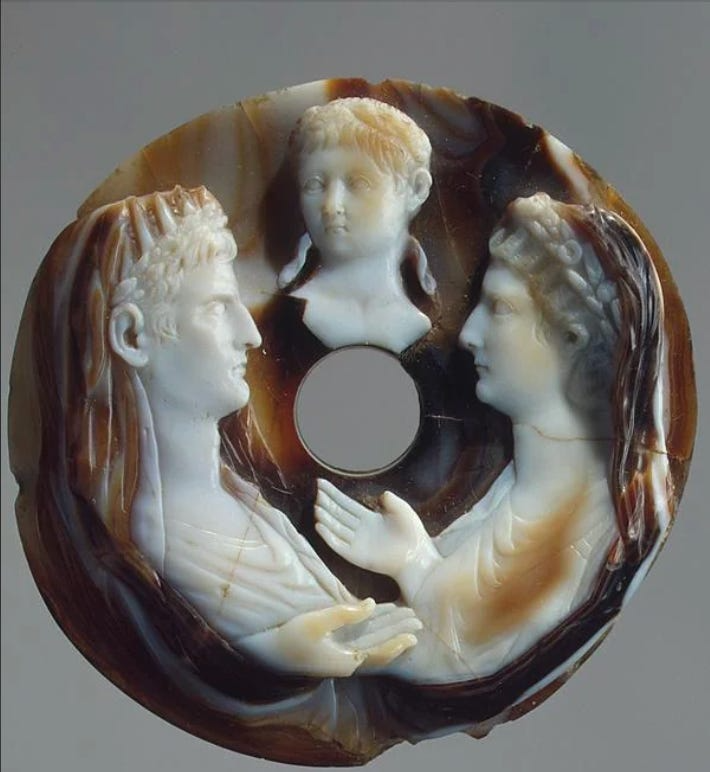
In this unequal game of musical mates, Nero once again found himself on the losing side. However, Octavian’s marriage to his former wife provided Nero with an opportunity to resolve his differences with the state’s brightest young star. Three days after Livia gave birth to Drusus, the blissful couple wed. There appeared to be no hard feelings between the two men; Suetonius reports that Nero gave Livia away at the wedding, acting “just as a father would.”
With two sons already born to the twenty-year-old Livia, Octavian must have been counting on a long line of heirs to carry on his imperial legacy with his third, final and most indelible wife. But he was sadly mistaken. The first imperial couple may have had many favorable attributes but fertility was not among them, and like all successful monarchies–though Octavian decried it—he needed heirs. It is an irony that, despite the formidable power that Octavian and Livia would eventually wield, they remained childless during their fifty-one year marriage.
Thus the fate of the Julio-Claudian dynasty rested solely on the fertility of its female kin, three of whom played key roles in early dynasty building. Octavian claimed Julian heritage through his adoption as outlined in his great uncle’s (Julius Caesar) will. The Julians were represented by Octavian’s older sister, Octavia Minor, who brought five children to the mix, three with her first husband, Marcellus (a boy and two girls), and two daughters with Mark Antony, her second husband. But Octavia’s children took a back seat to Julia’s five future children—three of them males. Finally, representing the Claudian contingency, Livia, brought her two sons (Tiberius and Drusus) into the mix.
Ever eager to marry his daughter off, Julia was betrothed at a mere two years of age to Antony’s oldest son and political heir Antyllus. That, however, changed abruptly when Octavian’s foremost in-law became his foremost enemy. Octavian’s next marriage scheme was to engage the hapless Julia to Cotiso, King of Getae (present day Bulgaria). Once again plans (and allegiances) fell through. It would take twelve years for another marriage scheme to surface.
By then, Octavian-cum-Augustus (in 27 BCE his handlers coined the term meaning “venerable one”) was the sole ruler of the Roman Empire. At long last, at the ripe old age of fourteen, Julia was wed to Octavia’s son Marcellus, Augustus’s beloved nephew—the next best thing to a son. The seventeen-year-old’s marriage to Julia put him next in line as chief successor to Augustus.
This affected Livia incredibly. Indeed, much has been made about her boiling with resentment over the elevation of Marcellus over her son Tiberius, also 17 years old. But then, after two short years into the marriage, Marcellus succumbed to an epidemic which swept through the Roman Empire and nearly killed Augustus. Alas, the marriage between the two first cousins produced no offspring.
In his Roman Histories, Cassius Dio reports on general rumors of Livia’s involvement in Marcellus’s death: “At this time it was said that Livia had had a hand in the death of Marcellus, because he had been preferred for the succession before her son (Tiberius).” He also makes a point of reporting that an epidemic was particularly harsh that year.
But if she had a hand in Marcellus’s death to elevate her son, it was all for naught.
WIthin a short year, Augustus betrothed his freshly-widowed daughter to his close friend and war hero, the mighty general and consul, Marcus Vipsanius Agrippa; a man twenty-five years Julia’s senior. There was one pesky detail that had to be attended to, Agrippa was already married; Augustus himself had arranged the union years ago to Marcellus’s sister, Claudia Marcella Major. Augustus—ever prioritizing political expediency over marital bonds—dissolved this marriage, allowing Agrippa and Julia to wed shortly thereafter.
Why Agrippa over the youth, Tiberius? The ancient chroniclers, who were quick to cast dispersions on Livia, made no note of her displeasure over the match with Agrippa. While it is not hard to imagine Livia’s disappointment at her son being passed over, her supposed grievance comes from I, Claudius alone. The truth is more complicated. General Agrippa had been disappointed in Augustus’s selection of Marcellus as heir two years prior. About Agrippa the emperor’s close friend and poet Gaius Maecenas wrote: “You have made him so great that he must either become your son-in-law or be slain.” Ever prudent, Augustus chose not to offend the man (or his legions) who won the Battle of Actium for him, so he made him his son-in-law instead.
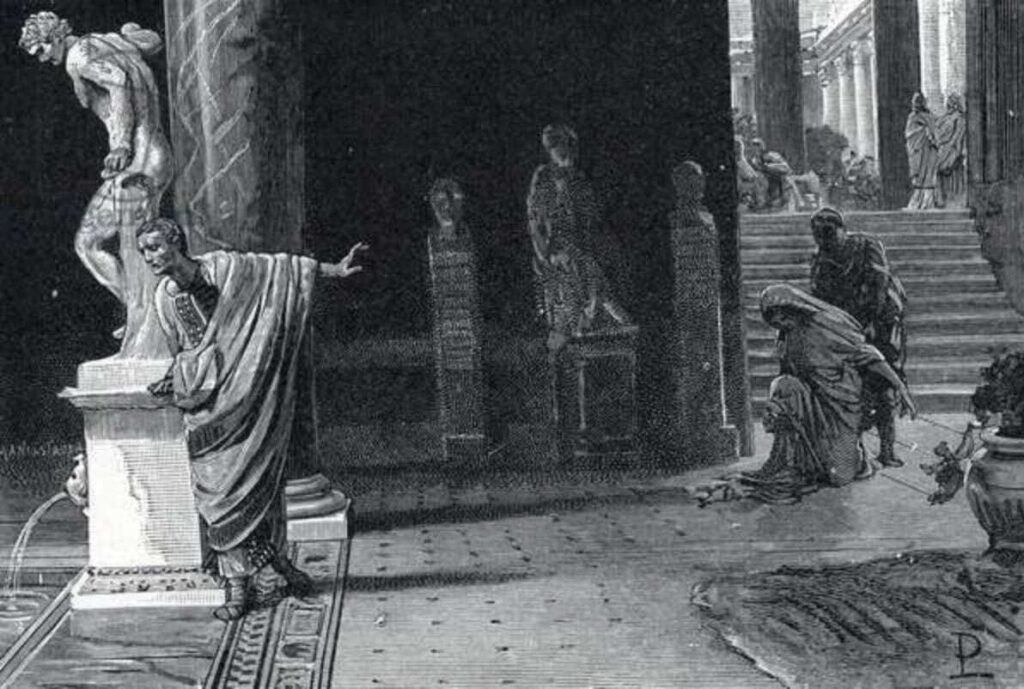
By all that is used to judge marriages for the time, theirs appeared to have been a successful one. In the nine years they were married Julia produced four children: two sons (Gaius and Lucius) and two daughters (Agrippina and Julia). She was pregnant with her fifth child (Agrippa Posthumous) when, while on a military campaign, Agrippa contracted a fatal illness and died in 12 BCE. No ancient historians ascribe Marcus Agrippa’s death to Livia; her alleged involvement is solely a product of Robert Graves’ imagination.
Even prior to Agrippa’s demise and ever-obsessed with securing his dynastic line, Augustus had formally adopted Julia’s two eldest sons (Gaius and Lucius) in 17 BCE— taking full possession of them lock, stock and barrel. In ancient Rome, adoption was a far-reaching matter in which a child officially became the son or daughter of the adoptive father, severing all formal ties to their biological parents.
Augustus needed to ensure that “his own sons” (the biological sons of Julia) would succeed him after his death. The still fertile, 27-year-old widowed Julia might attract an ambitious nobleman, potentially undermining his carefully laid plans; thus, Augustus swooped in, yet again, to handpick her next husband.
Hard on the heels of the birth of her fifth child and still in mourning for her husband, Augustus had his newly widowed daughter betrothed—this time to her step-brother—Tiberius. Once again, however, Tiberius was passed over as heir to the throne. As ever, Augustus prioritized Julian blood descendants; Tiberius, a military war hero was superseded as successor by his two supercilious prepubescent stepsons.
The marriage between the sullen Tiberius and the lively Julia was disastrous nearly from the start. As with Agrippa, Tiberius was already married—yet another marriage Augustus had himself arranged—when Augustus tapped him for marriage to Julia. According to Suetonius, Tiberius divorced Vipsania Agrippina (Agrippa’s eldest daughter with his first wife) “non sine magno angore animi “ (with great mental anguish). Unwittingly, Augustus had been responsible for a union that resulted in love. Upon their heartbreaking divorce, an inconsolable and pregnant Vipsania lost their second child. Thus the union between Julia and Tiberius had an inauspicious start with the star-crossed couple eventually finding it difficult to live under the same roof much less in the same bed. Tiberius— never a favorite of the emperor’s—felt slighted by his insolent step-sons who, as heirs to the throne, were increasingly promoted to consulships and distinguished priesthoods, while he with an acclaimed military background was relegated to diplomatic posts.
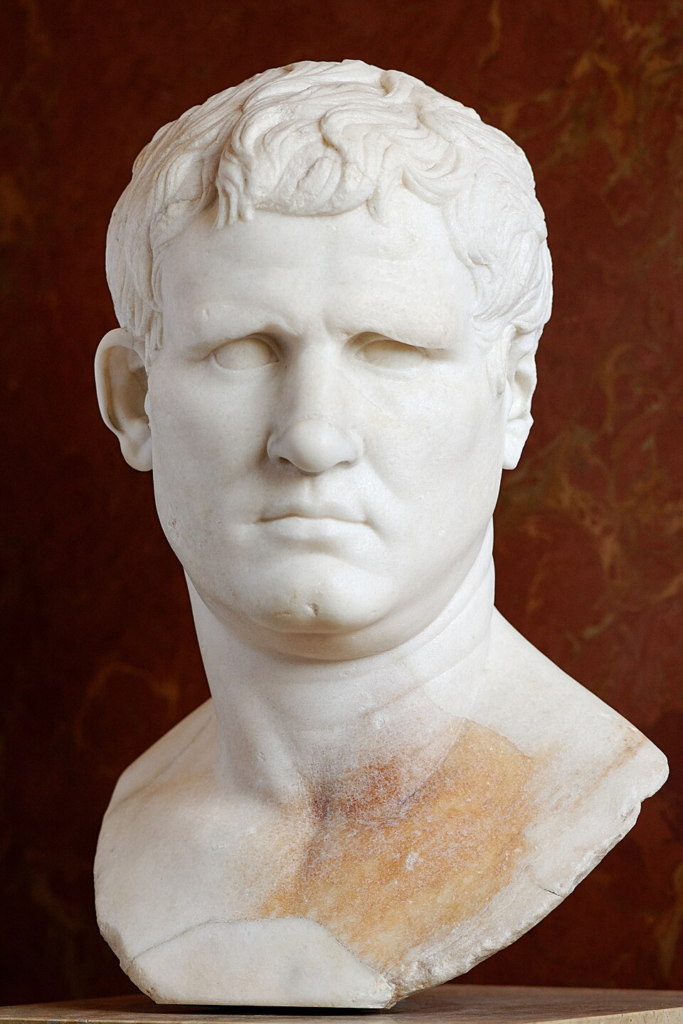
When Augustus offered him the tribunician power in the East—much to his dismay and the consternation of Livia—Tiberius announced his intention to “retire” from politics and move to the island of Rhodes where he would study philosophy for seven years. After Tiberius’s self-exile to Rhodes he was considered persona non grata at the palace and even considered a threat to the successors in the event of Augustus’s death. In fact, whether TIberius should be allowed to return to Rome at all was now determined by none other than Gaius, his 18-year-old stepson.
But providence had other plans for Augustus’s “own two sons.” Lucius died in 2 CE at the age of nineteen from a “sudden illness” while serving in a military command in Spain, and Gaius perished at the age of twenty-three in 4 CE in Lycia (present-day Turkey), likely due to an infected war wound. Tacitus cites their deaths, along with that of Marcellus, as examples of “fate’s cruelty or of their stepmother’s treachery,” employing an inherent bias against Livia without providing any substantial evidence beyond her role as a stepmother. While it is true that she had cohorts throughout the empire who could have assisted her in the endeavor, Tacitus does not elaborate on how Livia orchestrated the poisonings from two or three thousand kilometers away. Today most scholars reject the idea of her involvement in their sudden deaths, arguing that Augustus was no pushover—aptly demonstrated in his harsh treatment of his only child, Julia—if he discovered Livia’s treachery, she had everything to lose.
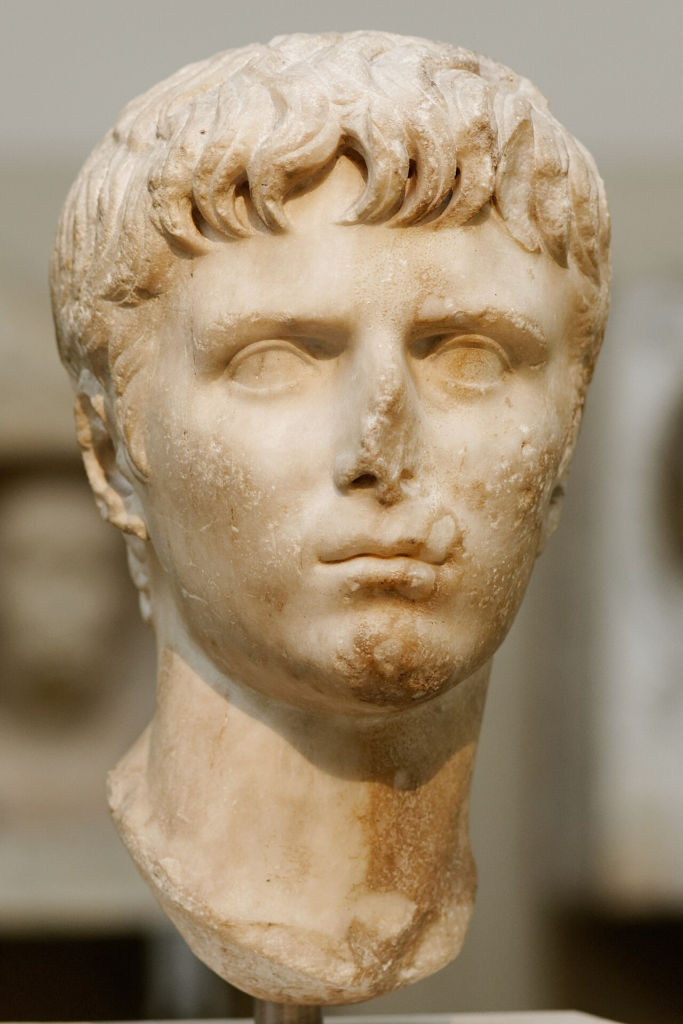
Nevertheless, with the unexpected death of both heirs, Tiberius’s moment had finally arrived. At forty-six years of age, back from Rhodes for two years, Augustus was ready to adopt Tiberius and make him his heir. But first a condition had to be met. Tiberius was required to adopt his nephew, his deceased brother’s (Drusus) son Germanicus, naming him as heir in place of his own son. Augustus (and much of Rome) adored the nineteen-year-old charismatic war hero who would soon marry Julia’s daughter, Agrippina the Elder. The “golden couple” would go on to have six children, including Agrippina the Younger and the Emperor Caligula. Germanicus enjoyed significantly greater popularity among the Roman populace than his stern uncle Tiberius, prompting Tiberius to openly convey his contempt for his adopted successor once he became emperor.
When Augustus adopted Tiberius he also adopted Julia’s youngest son, Agrippa Posthumous. His plan was to have a flow of succession: Germanicus would succeed Tiberius and Agrippa Posthumous would succeed Germanicus. Unfortunately, it was not to be. Not unlike Augustus’s successors, Tiberius’s successors had difficulty succeeding him too.
Within two years of Augustus adopting Agrippa Posthumus he began to have concerns about his grandson’s mental state. Suetonius writes: “…but he quickly disowned Agrippa due to his ferocious and sordid temperament, he was rather more unstable by the day.” But Agrippa Posthumous would eventually have had plenty of reasons to complain. In ancient Rome, after the death of his natural father, if an adoptee becomes emancipated by his adoptive father then he loses all property rights not only from his adoptive father who emancipated him but he also loses his inheritance from his natural father. Due to his dissatisfaction with his grandson, Augustus incorporated Agrippa Posthumous’s inheritance from Marcus Agrippa into his own estate.
According to Dio, Agrippa Posthumous often lamented that Augustus had “stolen his inheritance” and blamed Livia for her influence under the traditional charge of “stepmother’s avarice.” By this time his mother, Julia, had been in exile for six years. According to the ancients it was an exile that was blamed to some degree on Livia’s influence with the emperor. It is hardly surprising that Agrippa Posthumous would lay the blame of his incarceration on the empress. As ever Tacitus casts dispersions on Livia: “For so tight a grip had she on the ageing Augustus, that he banished his one surviving grandson, Agrippa Postumus, to the island of Planasia (today’s Pianosa).” Agrippa Posthumous would live on the island for another seven years until 14 CE when he was killed the day after Augustus died. The timing was flawless. Most scholars believe that Tiberius, to subdue political rivalry, had him executed by his guards. All three chroniclers concur on this premise; only Tacitus notes Livia’s hand in it as well. Subsequently, Tiberius’s refusal to investigate Agrippa’s murder fueled rumors of his complicity.
While questions remain as to whether she was complicit in Agrippa Posthumous’s execution or at least privy to it; most experts today dismiss the allegation that Livia murdered her seventy-five-year-old infirm husband. Although Tacitus speculates that poison was administered to Augustus, it was Dio, a century later, who elaborates on this idea, incorporating Livia’s involvement into the narrative: “(Livia) smeared with poison some figs that were still on trees from which Augustus was wont to gather the fruit with his hands; then she ate those that had not been smeared, offering the poisoned ones to him,” noting she ate safe figs first to avoid detection. He frames the accusation as popular suspicion tied to Augustus’s (allegedly) secret visit to Agrippa Posthumous,. The ancients are silent on why after fifty-one years she would attempt to kill her already infirm husband but all three report that the emperor’s last words were of a tender nature to his wife. Suetonius quotes Augustus’s last words: “Livia, live mindful of our marriage, and farewell!”
In 17 CE, three years into his reign, Tiberius appointed Germanicus, his widely favored heir, as supreme commander of the East in Antioch. Many believe he did this to distance Germanicus from his growing support in Rome, where his fame was considered a threat to Tiberius’s rule. At the same time, Tiberius also appointed Gnaeus Calpurnius Piso as the governor of Syria, ostensibly to surveil Germanicus and provide him with regular updates. Piso and his wife, Munatia Plancina, were close friends and confidantes of Livia.
Openly expressing his contempt for Germanicus, Piso often defied him leading to frequent conflicts between the two men. After falling ill, Germanicus accused Piso and his wife of poisoning him. According to Tacitus, some of his last words were: “that a man formerly successful and one who survived so many wars has been brought low by a woman’s treachery (muliebri fraude).” Was Germanicus discussing Plancina’s treachery or was Livia involved in his supposed poisoning as well? Tacitus is intentionally obscure.
Upon Germanicus’s death Rome was in a state of fury; the couple faced trial for treason, including the charge of poisoning Germanicus, which was, of course, impossible to prove. After Germanicus’s death, speculation arose that Piso was acting under Tiberius’s directives. During the trial, although Piso implored Tiberius to speak on his behalf, the emperor refrained from defending him and Piso subsequently took his own life.
Tacitus and Cassius Dio claim that as a close friend of hers, Livia pressured Tiberius into acquitting Plancina, thereby orchestrating her clemency. It was not until two decades ago that a surviving senatorial edict was discovered that corroborated this rumor, affirming Livia’s role in securing a pardon for her friend. Was Livia so stalwart in her support of Tiberius that she would have supported the woman who may have had a hand in the killing of her grandson? Scholars are divided, with many suggesting that she defended her friend from the poisoning charge simply because she believed Plancina was innocent. However, neither Tiberius nor Livia attended the funeral of his nephew or her grandson, leading many of their contemporaries to suspect their involvement in Germanicus’s untimely death.
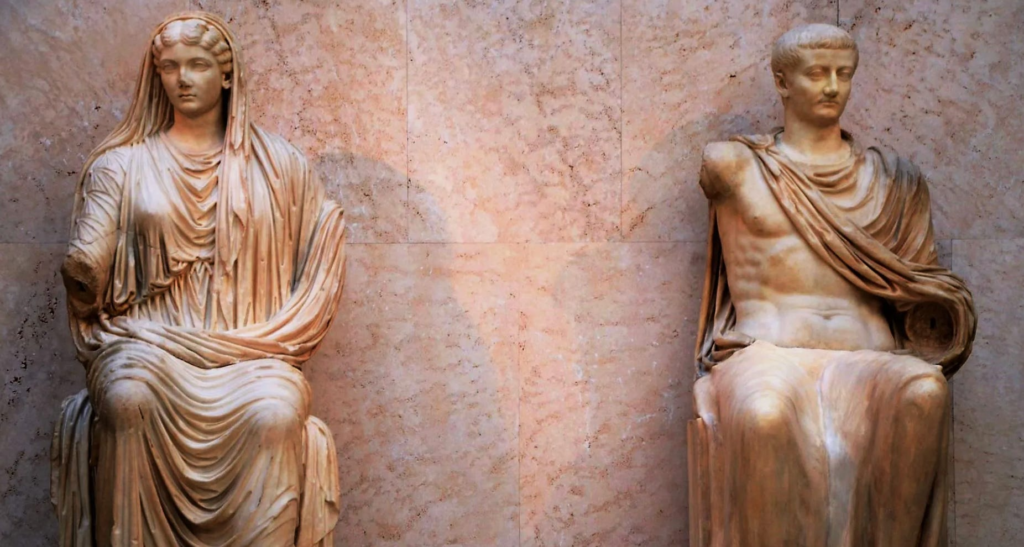
The deaths of Augustus’s heirs raise some unresolved questions. Is it possible that Livia poisoned Marcellus, as reported by Dio? Did she engineer the demise of Augustus’s “own two sons” from thousands of kilometers away, as Tacitus suggests? Could she have collaborated with Tiberius to contrive Agrippa Posthumous’s premature demise? What role, if any, did she have in the death of her grandson, Germanicus? The truth is that the ancient historians who documented her life frequently exhibited bias toward powerful women, which undermines the validity of each and every accusation they used against her. The majority of academics today think that during Livia’s lifetime, stories of her treachery circulated among her critics as idle gossip, unlikely to attract much attention. Perhaps our ongoing consideration of the role Livia played two thousand years ago testifies to the power she once wielded.
Published in Classical Wisdom April 2026