Twas thus She spoke—”that blush of shame proclaims thee Briton, once a noble name; First of the mighty, foremost of the free, Now honoured less by all, and least by me…lo! Here, despite of wear and wasting fire, I saw successive Tyrannies expire; ‘Scaped from the ravage of the Turk and Goth, thy country sends a spoiler worse than both. Survey this vacant, violated fane; recount the relics torn and yet remain…some retribution still might Pallas (Athena) claim, when Venus half avenged Minerva’s (Roman Athena) shame.” —an excerpt from Lord Byron’s “The Curse of Minerva”
Luring scholars, tourists, and history buffs from across the globe, the Parthenon and its neighboring monuments atop the majestic Acropolis have served as a glittering beacon of Western civilization, showcasing the seat of democracy, the genius of philosophical inquiry, and the beauty of the arts. Despite their fame, however, the temples have endured a troubled history. Often a target against the Greeks in their protracted struggle for independence, the Parthenon, in particular, has suffered irreparable damage from bombings and lootings. Among the incidents that caused the most pain, however, was the 1802 appropriation—and in some cases destruction—by Lord Elgin (and his agents) of various statues, metopes, and friezes known as the “Elgin Marbles.” Indeed, controversy surrounding the marbles has existed since their excavation. Today, their ongoing exhibition at the British Museum in London has become as infamous as the prior acts of violence against the Parthenon itself.
This paper examines the rationale for Lord Elgin’s appropriation of the marbles and reviews the authority he claimed to dismantle landmarks strongly associated with Greek cultural identity. Despite the controversy surrounding the seizure, what justifications did the British have for retaining the marbles? Following the pillage, Lord Elgin faced significant disgrace and misfortune, which inspired Byron to write about Minerva’s (Roman Athena) curse. However, regardless of the notoriety he gained throughout Great Britain, how did his life conclude? This study will address these questions from a historical perspective.
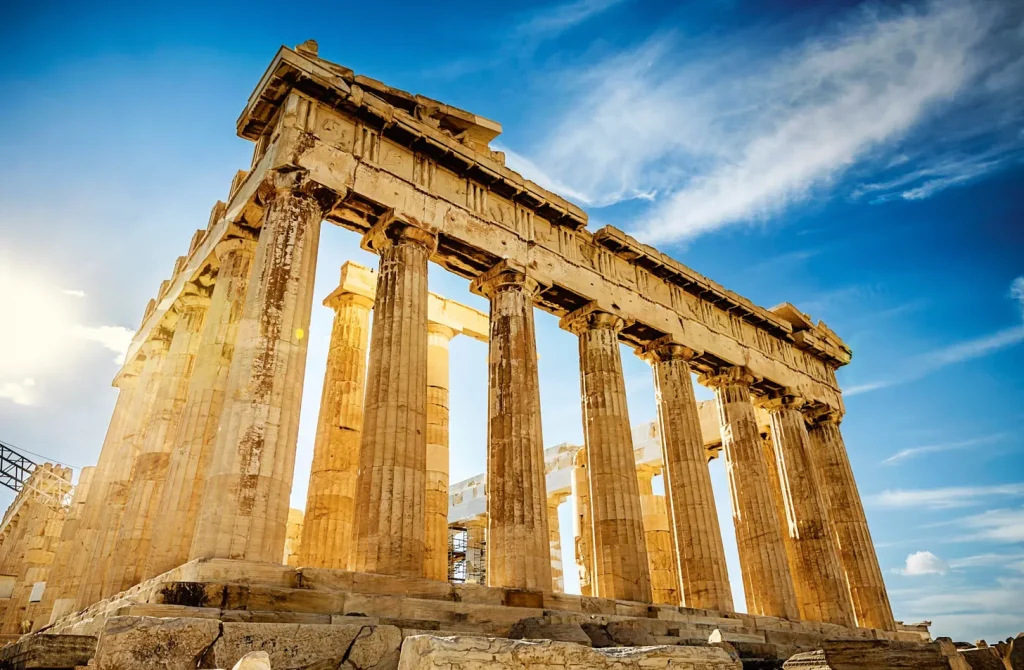
Before addressing the confiscation of the marbles, it is important to examine the most monumental of the structures and the circumstances surrounding its construction and eventual decline. A Doric temple which dominates the Acropolis hill in Athens, the Parthenon is dedicated to Athena Parthenos (Athena the Virgin) and was built between 447- 432 BCE during Athens’ so-called “golden age” under the leadership of Pericles (495-429 BCE).
Far surpassing the decoration of any other building from the classical age, the Parthenon was originally designed to replace ancient temples wrecked by the Persians, epitomizing Athenian power. Although it was a symbol of Athenian dominance, its reach was far and wide throughout the Greek world, where it was considered an emblem of Panhellenic pride. An example of this is how after his victory over the Persians, Alexander the Great (356-332 BCE) suspended twenty Persian shields beneath the pediments of the Parthenon as votive offerings.
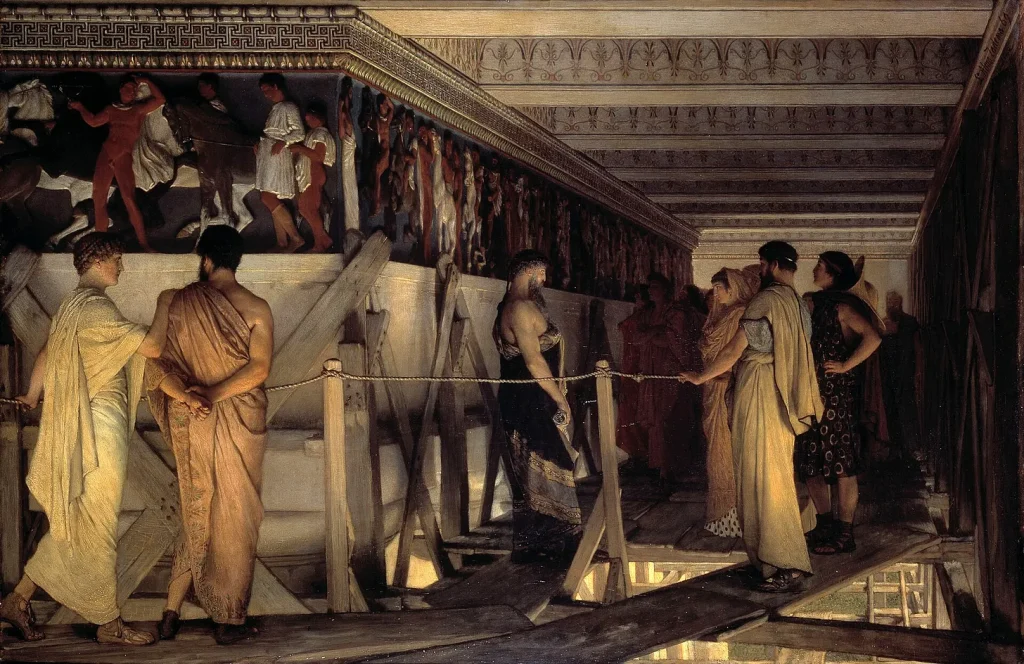
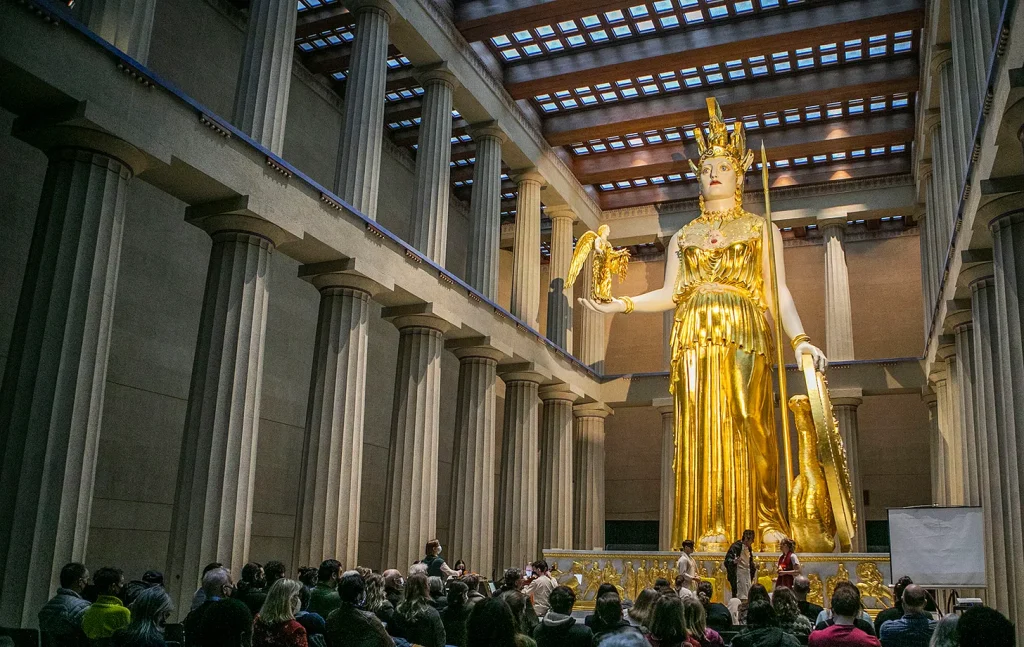
Built entirely of white, lustrous Pentelic marble from Attica, the temple was divided into two chambers. On the east side of the cella (inner chamber), as its centerpiece, stood the majestic and fully armed goddess of wisdom and war, Athena. Wearing a helmet and peplos (woman’s garment) and carrying a shield, a fierce Athena kept a watchful eye from her elevated perch over a vigilant city. The “artist in chief” of the Parthenon, Phidias, created the gleaming gold-plated ivory-and-wood statue, which rose to a prominence of twelve meters (39 feet) high. Effectively dominating the space, the gold weighed anywhere from 635 to 1135 Kg (1400 to 2500 pounds) and was detachable. To justify using public funds for the massive building project, Pericles decreed that if the state needed money, the gold could be melted down. In the west cella stood the opisthodomos (back chamber), which stored the treasures of the goddess and her city in the form of gold and silver vessels that were both sacred and state sanctioned. This area served as the Athenian treasury which was utilized for the state coffers.
The Parthenon originally featured forty-six columns organized in an octastyle configuration, including eight columns on each short side and seventeen columns along each long side. The four corner columns counted only once, resulting in a total of forty-six columns. There were ninety-two metopes (rectangular carved panels) in high relief (thirty-two on each side, fourteen on each end) demonstrating scenes from Greek mythology and of special Athenian interest. The frieze contained the metopes and was in low relief, extending to 160 meters (525 feet).
For nearly two millennia—from its completion in 432 BCE until 1687 CE—the Parthenon remained essentially unaltered. The exception to this timeline was a fire by an invading Germanic tribe when it sacked Athens in the third century CE (267) and partially damaged the Parthenon. The Parthenon was restored during the reign of Julian they Apostate, ninety-four years later.
On the fate of the magnificent Athena, last mentioned in the first millennium, she is lost to the historical record and was likely dismantled for her precious gold and ivory.
Although it would remain largely intact, the Parthenon’s decline began in the fifth century CE during the reign of Theodosius II (408-450 CE), when it was closed by decree and, shortly thereafter, like many pagan temples, converted into a Christian church. Nevertheless, because of its continuous use as a significant religious building—first as a Christian church and subsequently as a Muslim mosque— a large portion of the architectural design endured allowing it to fare significantly better than many other ancient buildings. By the 17th century, however, the Parthenon was highly vulnerable when the Ottomans used it as a storage facility for gunpowder. In their conflict with the Venetians over control of Greek lands and harbors, a mortar round struck the Parthenon in 1687 resulting in an explosion that blew off the roof and some of the walls, killing many people and leaving the Parthenon in ruins. After the explosion, the Parthenon was treated by the Ottomans as a damaged monument to a bygone era. This neglect would in fact lead to the seizure of the marbles.
Prior to his appointment as ambassador to the Ottoman Empire, Lord Elgin (Thomas Bruce, 1766-1841) had a successful diplomatic career promoting British interests across several European countries. The seventh Earl of Elgin, Bruce was a Scottish nobleman, and collector of antiquity who was appointed to serve as ambassador to the Ottoman Empire from 1799 to 1803 by King George III.
During this period, there was significant interest in the classical world, with numerous Europeans undertaking a cultural pilgrimage to explore the ancient past known as the Grand Tour. This interest in all things classical was fueled in part by Napoleon (1769-1821) when he transformed classical antiquities into geopolitical prizes. Upon each conquest of lands that had once been in the Greek or Roman world, his agents collected antique works for the Louvre (renamed by Napoleon to “Musee Napoleon” from 1803-1814) intensifying the rivalry between the European superpowers of the day: Britain and France.
Another matchup between the two superpowers occurred during the 1798 Battle of the Nile when Napoleon attempted to seize Egypt, long a province of the Ottoman Empire. Britain came to their defense and was victorious over France which helped facilitate a working alliance between Britain and the Ottoman Empire. Not only did Britain secure the Ottoman Empire as an ally but it also won most favored nation of the Turkish state.
As British ambassador to the Ottomans, Elgin exploited his position in his quest for artifacts for personal gain. But it all began innocently enough. Initially, he sought copies of the marbles for his estate, which was undergoing renovation. When the British government turned down his request for funds to help pay for the drawings and casts of the Acropolis, he hired artisans and paid for them at his own expense. He would soon grow frustrated with the Ottoman authorities for restricting access to the Acropolis to his workers; the Ottomans were using the Acropolis as a military fort with constrained access and denied passage to outsiders. A whole year transpired when the artisans were on Elgin’s bankroll but yielded no results. Elgin applied to the Ottoman government “to measure, sketch and make plaster molds” of the monuments and in 1801, Elgin obtained a firman (official permit) from the Sultan to bypass the restriction to enter the Acropolis—at long last allowing his men to begin work.
Unfortunately, the original Turkish text in the firman has been lost and exists only in an ambiguous Italian translation. The Italian translation leaves unclear what Elgin was permitted to excavate: “And when they wish to take away any pieces of stone with old inscriptions and figures, let no opposition be made thereto.” Most scholars today agree that the firman allowed for drawings and rubble excavation and that the above quotation refers to collecting loose stones not affixed to the walls; it did not explicitly authorize the removal of the large sculptures that were still attached to the monuments. Nor did it permit Elgin to demolish any part of the structures.
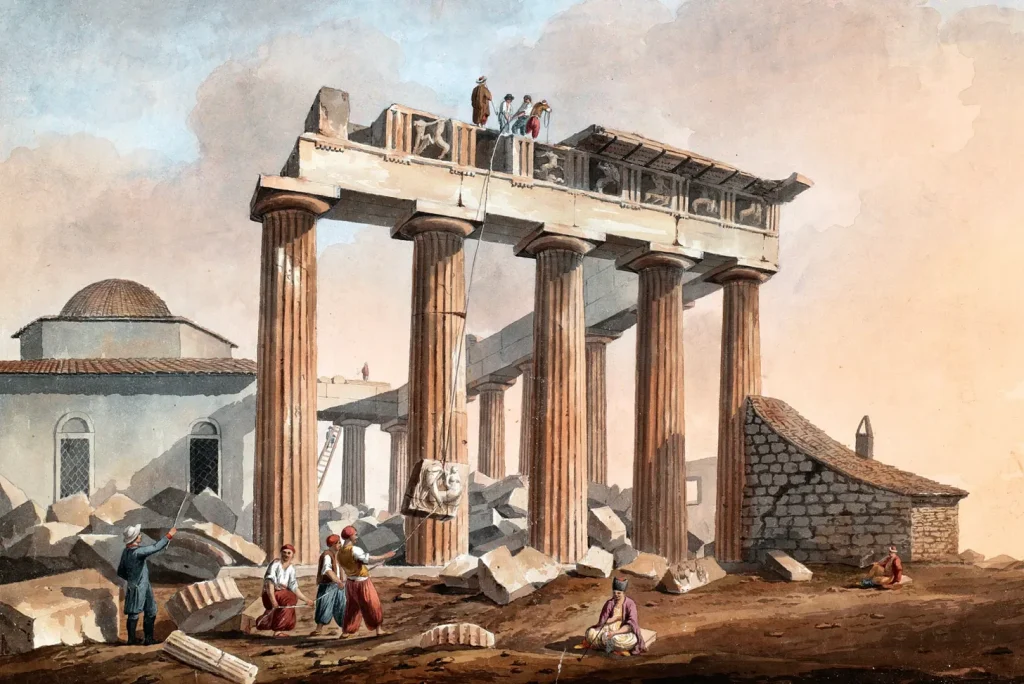
WIth the firman in hand, his workers were able to scaffold allowing them to examine the marbles up close. However, it was not until Elgin’s secretary was granted permission by the Ottoman governor to remove a statue, that his men discovered how easily corruptible the local authorities were. Elgin used his office to extend the interpretation of the firman, allowing them to hack off one piece of marble after another using bribery to their advantage. By this time, Elgin’s workers were employing saws, hammers, and chisels to forcefully remove the marbles from their foundations.
The act of removing the marbles was a desecration in itself but the crude archaeological instruments that were used in the day contributed to its destruction. An example of this is when metopes were extracted from the Parthenon’s walls, the sculptures were deliberately chiseled and cut from the structure, thereby weakening it. Moreover, because the architectural elements were all tightly bound together, the removal of the topmost cornices often led to the destruction of the entablatures and triglyphs that surrounded them.
It is sad irony that the defilement of a monument honoring their heritage was a thankless task that many local Greeks were forced to undertake for economic reasons. Prominent among the craftsmen that Elgin employed was Giovanni Battista Lusieri who supervised the effort. Lusieri had established his career as a pioneering Neapolitan landscape artist not unlike the brilliant “painter of light” J.M.W. Turner, whom Elgin initially sought to recruit. Turner and Elgin, however, could not come to terms; Turner did not want to lose artistic control of his drawings and required more remuneration than Elgin could provide.
Over the years, much has been made of Lusieri’s damaging techniques but it is important to note that at the time that Lusieri excavated the Parthenon, archaeology as a discipline did not exist. The techniques Lusieri and his team implemented were rough builder excavation techniques: largely unrefined marble extraction and salvage.
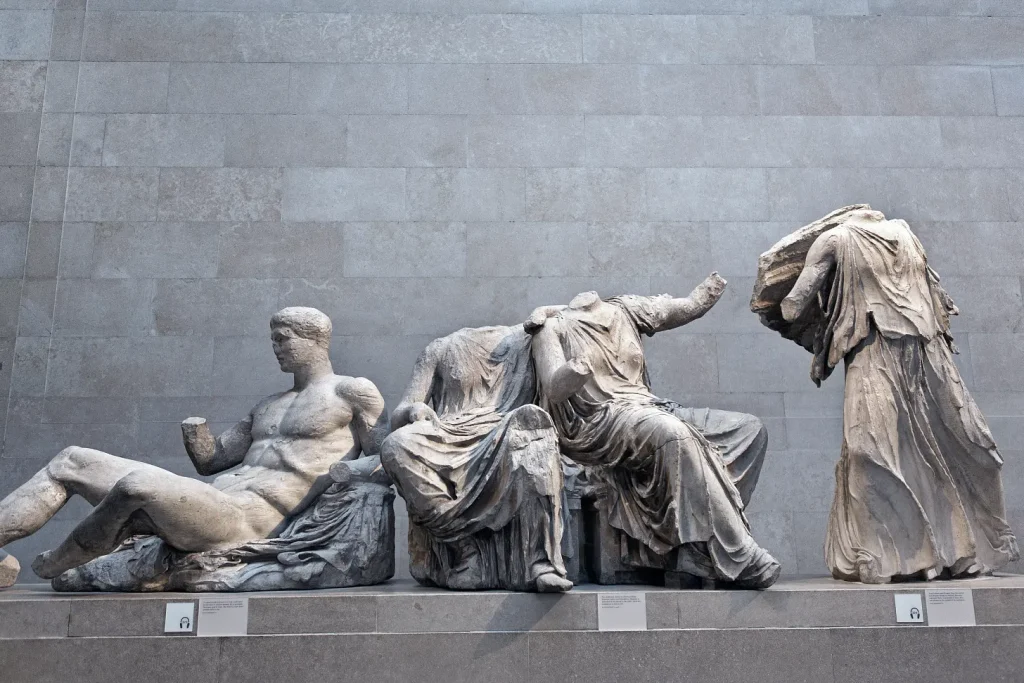
Ultimately, his men would confiscate two-hundred and forty-seven of the five hundred and twenty-four feet of frieze from the Parthenon. Out of the ninety-two metopes, they removed fifteen and seized seventeen sculptures from their pediments. But this only accounts for the Parthenon, Elgin’s men also seized sculptures and architectural elements from both the Temple of Athena Nike and The Propylaia. At the Erechtheion, they infamously removed both an Ionian column and a Caryatid. Originally, Elgin wanted all six of the caryatids but had to make do with only one of them which his men replaced with a common brick column, to the imagined horror of Athena, not to mention the Greeks.
Although Elgin expanded the limits of what could be removed, the truth is he would have plundered even more marbles if not for an injunction against further excavations by the Ottoman governor of Athens in 1805. Prior to the injunction Elgin’s agents were planning to remove the western frieze of the Parthenon.
Over the course of fifteen years Elgin shipped approximately two-hundred crates of the marbles from Athens to London aboard several ships. One of the ships was shipwrecked because it was overburdened by too heavy a load of (seventeen crates) marbles thereby making the ship less stable. Once again, Elgin incurred significant expense to rescue and restore the waterlogged marbles, a process that took nearly three years.
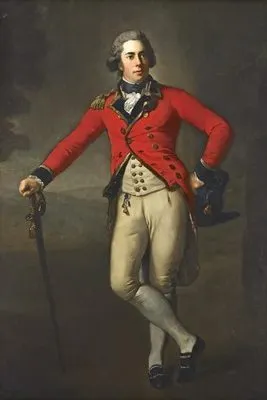
Up until his sack of the marbles, Elgin led a charmed life. At a young age his career trajectory was well established, and due to his favorable career prospects, he was successful in his pursuit of one of the richest heiresses of the British Isles: Mary Nesbit. Not only was Nesbit a stunning beauty, but she also brought to the marriage a considerable dowry, which Elgin would use to finance his acquisition of the marbles along with his ambassadorial household expenditures in Constantinople. A profligate spender of his wife’s fortune, as the years progressed Elgin sank deeper and deeper into debt.
After the acquisition of the marbles, his circumstances began to deteriorate, leading to a series of humiliations, the first of which was his disfigurement. Two competing narratives exist regarding Lord Elgin’s deformities, one more charitable than the other. In the first, Elgin was a chronic asthma sufferer, which his presence in Constantinople exacerbated. During his time there, he underwent a therapy involving liquid mercury, which resulted in facial deformities, particularly the loss of part or all of his nose. The less charitable account tells of his mercury use for the treatment of syphilis, considered a remedy of sorts for the time.
If Elgin thought that his disfigurement would be the worst of his troubles, he was mistaken. During a journey to Lyon, France in 1803, Elgin faced imprisonment for three years when the Napoleonic Wars began to resurge. Napoleon, wanting the marbles for the Musee Napoleon, promised Elgin his freedom in exchange for them. Elgin steadfastly refused, choosing prison instead. During his incarceration, Lady Elgin took up with another. When he discovered the affair, Elgin sought a divorce, which led to a salacious divorce trial in 1808. Although Lady Elgin was denied custody of their five children, she won back her fortune, to which Elgin mistakenly believed he was entitled.
Meanwhile, the marbles began arriving in London, where Elgin had them mostly warehoused in a special shed on his estate. In a letter he admitted that the marbles were “in the coal shed at Burlington House, decaying from destructive dampness.” Their total time spent in sheds or storage was twelve years, from 1804 to 1816. When not housed at his estate, the storage fees alone were exceedingly high.
Because he had to borrow to afford the ill-fated project, by this point, creditors were pursuing Elgin, leaving him financially strapped. Due to his precarious financial situation, he was unable to retain the marbles for his estate as he had originally planned. In 1815 he made overtures to the British government, originally asking for £100K for the marbles, which he reduced to £74,000 to recap his significant expenditures. In 1816, his activities were thoroughly investigated by a Parliamentary Select Committee. After extensive deliberation, ultimately the government decided that the sculptures were acquired legally and because they were of “high artistic value” the committee voted 82 to 30 to secure the marbles but for less than half the amount Elgin was asking (£35,000).
Initially the public was decidedly against Lord Elgin’s excavatory adventures. In removing the Greek sculptures, Lord Byron accused Elgin of “cultural imperialism” and many notables of the day condemned Elgin of “rapacity, vandalism, and dishonesty.” As a defense to the charges, Elgin stated that he feared the Ottoman’s neglect of the sculptures would lead to their destruction. Furthermore, a report from the Parliamentary Select Committee includes Elgin’s assertion that he took the marbles to better serve the cultural interests of Great Britain, stating they were “beneficial to the progress of the fine arts in Great Britain.” However, it was never his original intention to donate them to the British public; he initially intended for the marbles to adorn his estate as a private collector. His imprisonment, costly divorce, and the exorbitant excavation fees led him to sell the marbles out of financial necessity. Perhaps admirers of Classical Greek architecture have Elgin’s insolvency to thank for the marbles’ presence in a museum and not holed up in someone’s private collection.
Eventually the public was mixed about the marbles with some decrying their brutal fragmentation while others praised their antiquated beauty. The debate opened up a wider dialogue over the ethics and duties of individuals who excavate cultural artifacts. It has long been argued by Elgin’s supporters that, although damage occurred both to the marbles and the monuments themselves, Elgin and his men ultimately preserved the sculptures from the destruction and desecration they might have faced if left in their original environment. However, critics today contend that this perspective reflects a colonial mindset, akin to how an empire might view its subordinate state, suggesting, “If you cannot take care of these artifacts, we will take them from you.”
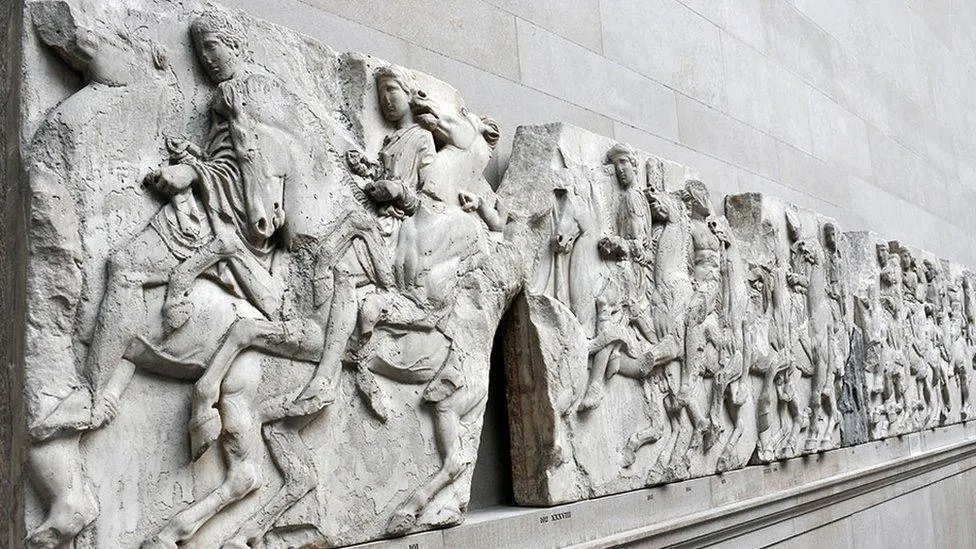
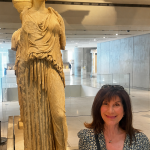
Great Britain officially acquired the marbles in 1816 for the British Museum, in 1822—a mere six years later—Greece declared independence from the Ottoman Empire; in 1832 it was decreed an independent nation—-within two years Greece made its first official request for the marbles to be returned. For over two hundred years, Britain has held steadfast in their possession of the marbles. The British excuse for holding on to them in order to preserve them has been indefensible for some time. In 2009, Athens built the new Acropolis Museum directly across from the glittering Acropolis which houses many of the marbles’ companion pieces and sculptures from the monuments. The lonely Caryatid who stands by herself at the British Museum is aching to be reunited with her five sisters who grace the airy and light-filled Acropolis Museum.
Today the talks between the two countries are at their most advanced stages in decades with negotiations described as “close to completion.” A key sticking point is a British act of parliament forbidding museums from relinquishing any objects in their collection; the simpler path is for the British Museum to “loan” Greece the marbles, a solution neither side has agreed upon. Another contentious issue is the fear that the return of the marbles to Greece will set off a tidal wave of “source countries” requesting the return of their cultural artifacts from major museums. Theoretically, such a movement could empty most major museums. Supporters of the return of the marbles counter that the seizure of the marbles is an exceptional case that will not set a standard. Nevertheless, the debate continues. In the spirit of international cooperation the hope for many is that the marbles will be returned to their cultural homeland as both sides strive for a mutually beneficial resolution.
Though the fate of the marbles is currently unsettled, what was to become of Lord Elgin? Could Athena’s curse have impacted the trajectory of his life? Following his scandalous divorce and the sale of the marbles for less than half of what he had spent on them, he faced financial ruin. Compounding his troubles, his notoriety over the marbles caused him to lose his seat in the House of Lords in 1807, and he suffered great shame. Yet, despite his disrepute, disfigurement and bankruptcy, in 1810 he managed to marry again—this time to Elizabeth Oswald, a woman twenty-four years his junior—and fathered eight children with her. Due to the persistent harassment from creditors in Britain and the looming threat of debtor’s prison, Elgin eventually relocated his brood to France, where he could enjoy his later years in relative peace and comfort—he was still landed gentry, which his creditors (and evidently Athena herself) could do nothing to redress. He died at age 76.
Published in Classical Wisdom Magazine