“The greatest glory of a woman is to be least talked about among men, whether for good or for bad”
Pericles’ Funeral Oration, Thucydides:
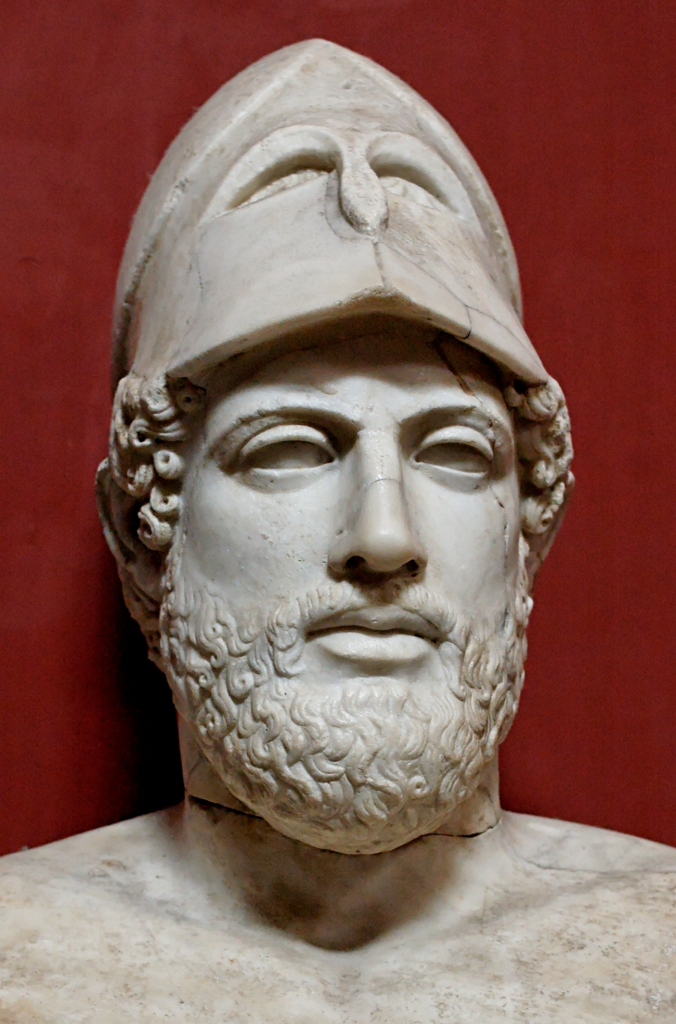
Most scholars of the ancient world would likely agree that the only certainty regarding antiquity is its inherent uncertainty. Perhaps no individual exemplifies this paradox more than Aspasia of Miletus (470-400 BCE), a female philosopher known primarily as a rhetorician, dialectician, and philosophical educator as well as partner to the prominent 5th-century BCE Athenian statesman, Pericles.
Much of what has been attributed to Aspasia comes to us through the filtered lens of writers whose accounts reflect the gendered biases of the day. Over the years, historians have frequently regarded these slanted narratives as established truths; yet, can ancient chroniclers, many of whom were comedic playwrights parodying Aspasia, have accurately recounted the life of a powerful woman without inherent bias?
So who was the real Aspasia? While in a committed sixteen-year live-in relationship with Pericles, could she have been a courtesan running a brothel, as some authors insist? In another sphere, was she a teacher to the incomparable philosopher Socrates? And as Plato records in the same Socratic dialogue, did she assist Pericles compose his renowned funeral speech?
Though many today contend she wrote essays and treatises, like Socrates, she did not leave behind any writing. Stitched from whole cloth, Aspasia’s purported life continues to spark debate to this day, but based on unreliable sources, can we ever know who she truly was?
The Powerful Metic
What we do know about Aspasia is that she was not from Athens. It is widely accepted among scholars that she hailed from the Ionian colony of Miletus and was of an affluent family that prioritized the education of its daughters. In fact, Miletus has been frequently acknowledged as a fertile ground for historians, rhetoricians, and other academics where its women led less secluded lives than their Athenian counterparts. At about twenty years of age, around 450 BCE, Aspasia came to Athens and some time shortly thereafter she met Pericles.
Likely the power couple met at a symposium where the middle aged leader was quickly smitten by the erudite young woman. So enamored was he that in Life of Pericles, Plutarch (45-119 CE) reports: “Everyday, he came from the marketplace, he saluted and kissed her.”
While Pericles divorced his wife of ten years and mother to his two sons sometime before he met Aspasia, they could never marry. Just one year prior, Pericles adopted legislation in which Athenian citizens were prohibited from marrying non-Athenians and producing legitimate offspring with them. Nonetheless, Aspasia moved in with Pericles and eventually they had a child (also called Pericles) whose status would ultimately be legitimized after petitioning the assembly for a special exemption when Pericles’ legitimate sons both died. They may have had daughters but because they were female, they don’t show up in the record.
To be sure, citizenship was a status conferred only to males, meaning that there were technically no female citizens in ancient Greece. However, there was a primary distinction between citizen-wives and their metic (foreigner) counterparts: the legitimacy of their offspring, namely the procreation of citizen males and the assurance of future inheritance. As a result, citizen-wives were considered to be of higher status than their metic counterparts, but such status came at a cost.
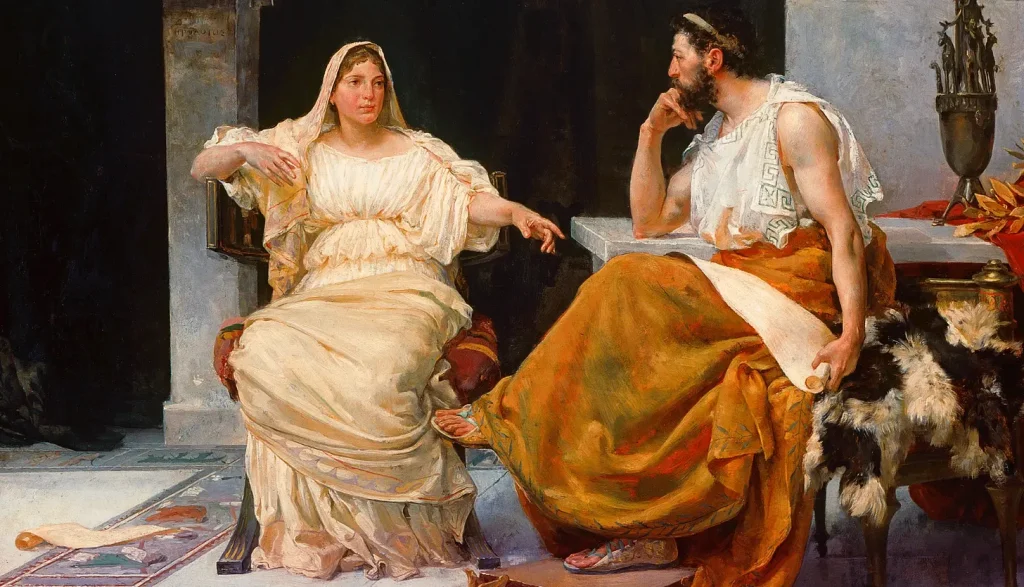
Proper citizen-wives were expected to stay confined to their homes, only venturing out for funerals or female only religious festivals, while affluent metics like Aspasia would have enjoyed greater freedom to navigate the thoroughfares of the city. Aspasia could host gatherings and participate in political and philosophical conversations within intellectual circles that were frequented by prominent men—activities that were off-limits to citizen-wives.
Because of the freedoms she enjoyed and her close relationship with the most prominent man in Athens, Aspasia became a powerful woman whose notoriety made her a target for bawdy jokes and innuendo. As a matter of record, ancient writers often discussed the sexuality of powerful women to delegitimize their authority and reinforce gender subjugation.
Though Aspasia might have been among the classical world’s earliest powerful women to encounter unjust treatment from male writers, she was by no means its last. This pattern is especially apparent in the chronicles of the ancient Roman authors in their debasement of Julio-Claudian women who were close to the centers of power. As a form of degradation, disparaging powerful women was a way to undermine their credibility and question their moral integrity.
The Comic Curse
Alas, the only contemporaneous evidence we have of Aspasia’s life comes from fifth century (BCE) comedic plays which paint her in a harsh light. Comedic plays served as a humorous vehicle for political and cultural insinuation; thus, by mocking Aspasia, they could denigrate Pericles by association.
Among a handful of Attic comedies that refer to Aspasia with sexual undertones, is Aristophanes’ Acharnians, a play about an ordinary Athenian citizen who is weary of the Peloponnesian war and seeks to make a separate peace with Sparta.
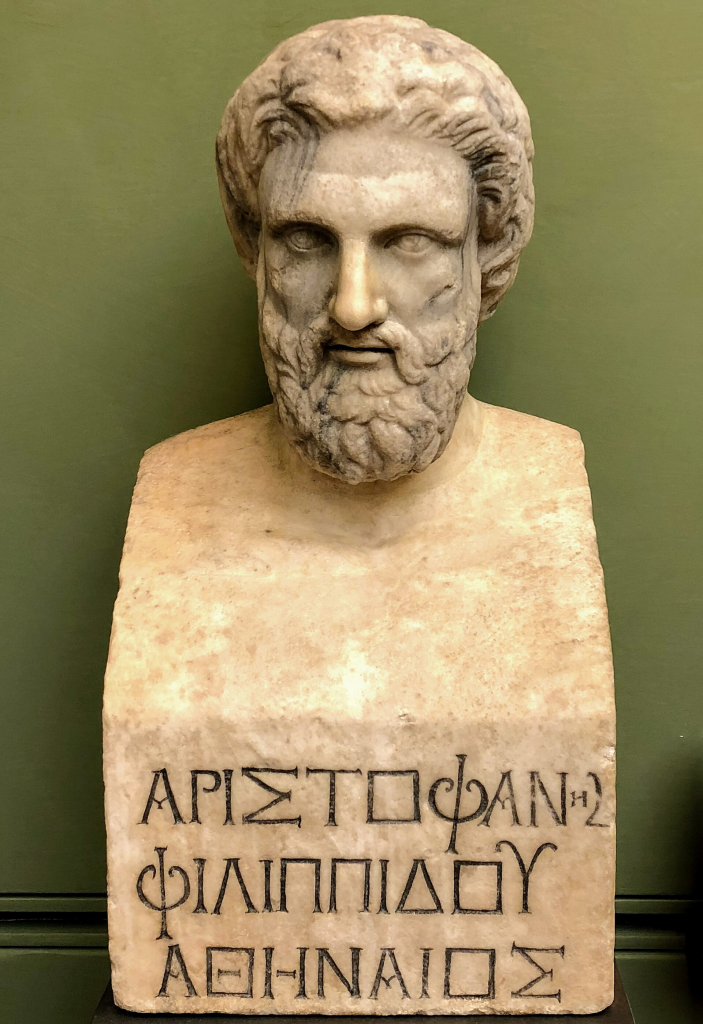
“But, then some young drunks went to Megara and stole the whore Simaitha. Well, the Megarians were driven crazy by this insult and stole in return two whores from Aspasia. From this began the Great War in all Hellas-–from three cXXX sXXX sluts.” (Ach. 516-539)
These depictions of her as running a brothel have significantly shaped and distorted how future historians have constructed her story. Historical accounts of her life often mention her managing a brothel and even some modern historians accept these narratives from comedic plays as unvarnished truth. It is highly unlikely that she operated a brothel given her committed relationship with Pericles, the most prominent Athenian lawmaker of the time… and yet, her close relationship with the powerful lawmaker is the reason for her stigmatization.
But managing a brothel was not the only way for which she was disparaged. The ancient comedic writers had many names for her, such as: “all-whore,” “she-goat,” and “dog-eyed concubine.” Her severe depiction in the comedic plays underscores her considerable impact in 5th-century BCE Athens… of which there were many.
Known for attacking political figures, especially Pericles, Hermippus is another 5th-century (BCE) comic playwright who is associated with a scurrilous narrative about Aspasia. Plutarch records that Hermippus brought a charge of “impiety” against Aspasia for “procuring free-born women for Pericles” that resulted in a trial. Contrary to what Plutarch reports, most experts think it highly unlikely that as a woman (especially a metic) she would have been afforded the privilege of a court trial. Indeed, even citizen- wives would not have garnered a court trial because they were not viewed as independent legal entities. As a metic, Aspasia’s legal status would have been considerably more diminished. Most probably, the trial Plutarch discusses was part of a scene lampooning Aspasia in one of Hermippus’ plays and not historical fact.
In addition to sexualized slander, historical accounts depict her as a politically dangerous foreigner who purportedly influenced Pericles’ policies both home and abroad. Another rumor was Aspasia, like Helen of Troy, was responsible for the start of a war. Due to her leverage with Pericles, 4th century BCE historian Duris, held her accountable for the start of the Samian War. This claim arises from the fact that her homeland of Miletus was a rival of Samos. Thus, it was reasoned that she influenced Pericles in backing Miletus in their dispute with Samos over control of the city of Priene. Today many argue that this rumor is as unreliable as most of the fabrications that accompany her historical narrative.
Flattering Satire: Plato’s Portrayal
While the accounts about her depravity stem from dubious sources, the truth about her merits may be ambiguous as well. Plato composed the Socratic dialogue, Menexenus, in 385 BCE, ten to fifty years after the deaths of Pericles, Aspasia, and Socrates. As a parody of the so-called “Golden Age” of Pericles, it features only two characters, Socrates and Menexenus, the eponymous young Athenian interested in public policy. The dialogue is characterised by jingoistic embellishments and historical fabrications, notably crediting Aspasia with mentoring Socrates and writing Pericles’ famous funeral speech.
Most scholars concur that the work is a satire of the epitaphios (funeral oration) and the civic values it extols. Assuming the role of orator, Socrates takes center stage to expose how public speeches can sway the emotions of citizens. The essence of the dialog is a funeral oration narrated by Socrates and composed by Aspasia for Pericles:
: “….yesterday I heard Aspasia composing a funeral oration about these very dead. For she had been told, as you were saying, that the Athenians were going to choose a speaker, and she repeated to me the sort of speech which he should deliver, partly improvising and partly from previous thought, putting together fragments of the funeral oration which Pericles spoke, but which, as I believe, she composed.”
Aspasia is introduced as “an excellent mistress in the art of rhetoric.” However, Plato undermines the significance of rhetoric by having Socrates describe the funeral oration as unoriginal and formulaic. Many contend that by attributing the speech to Aspasia, Plato highlights the deceptive nature of public oratory and its inherent irony, since the speech was not authored by a respected statesman, like Pericles, but rather by his female companion, Aspasia. Plato might be joking with a purpose, but there is a semblance of historical accuracy which draws on real traditions about Aspasia’s intelligence and rhetorical influence.
Due to its satirical nature, scholars continue to debate whether Menexenus is mere parody or offers historical accuracy as well. Did Aspasia mentor Socrates, as the dialogue suggests? As contemporaries, the two were likely colleagues and collaborators but scholars are divided as to whether she mentored him. Similarly, there has been vigorous discussion regarding whether she wrote Pericles’ famous funeral speech. Given her background and her intimacy with Pericles, it is probable she helped him craft the speech at some level, but as with much else, this remains unverified.
The Educator: Xenophon’s Version
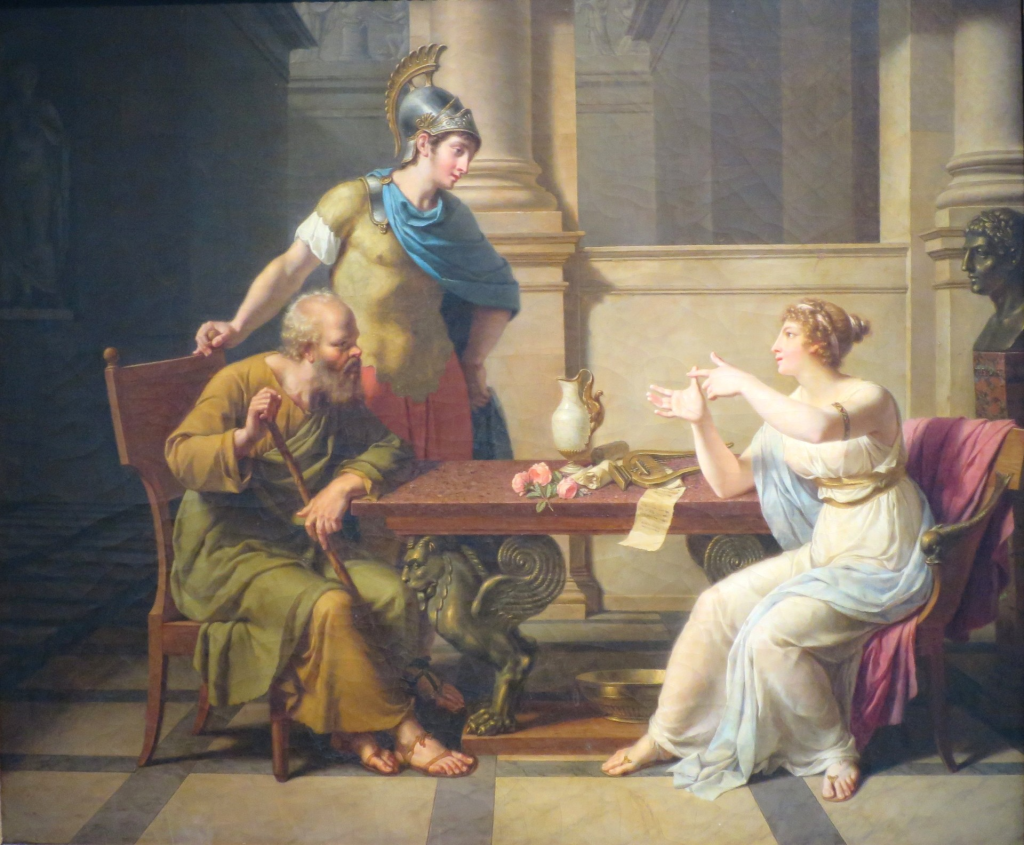
Plato was not the only Socratic philosopher who wrote about Aspasia’s work. The fourth century (BCE) Greek historian and philosopher Xenophon was also a follower of Socrates and ranks second only to Plato as a source of our understanding of him. In two of his works, Memorabilia and Oeconomicus, he portrays Aspasia as a brilliant philosopher associated with persuasive speech, advice on household management, and the education or instruction of others. In Plato’s satire, Aspasia is a proponent of a degenerating rhetorical tradition, while Xenophon emphasizes her ability to educate women in domestic matters and to guide couples in lasting relationships.
Xenophon’s Socrates in Oeconomicus praises Aspasia’s expertise on the education required for wives in household management: “I will introduce Aspasia to you, since she knows much more about the matter than I do, and will explain everything to you.”
In classic Socrates fashion, he leverages the expertise of a known authority, in this case Aspasia, to bolster his argument and emphasize the specialized nature of such knowledge—something seen infrequently in the accounts about her.
While historical records do not definitively establish Aspasia as the first woman to instruct other women in domestic management and what we now refer to as home economics, she remains one of the earliest women identifiable in the sources who fulfilled such a role.
Cicero’s Account
Another account of her rhetorical skills comes from Cicero’s (100-46 BCE) De Inventione when he quotes a lost dialogue by 4th century BCE philosopher, Aeschines of Sphettos, which highlights Aspasia’s experience in couples’ counselling. In the following quote she finishes advising Xenophon and his wife to be the best partners for each other:
“That is, you, madam, wish to have the best husband, and you, Xenophon, desire above all things to have the finest wife. Therefore, unless you contrive that there be no better man or finer woman on earth you will certainly always be in dire want of what you consider best, namely, that you be the best husband of the very best of wives, and that she be wedded to the very best of men.” Aspasia is reframing a successful marriage by making it a reciprocal project where each partner focuses on how best they can improve upon themselves for each other.
Aspasia was a rare woman in the ancient world who was a respected authority in her field rather than a solely marginalised stock figure. The above passages by Xenophon and Aeschines are among the few surviving instances of classical writing where Aspasia appears as a proficient expert rather than a satirical or scandalous figure. Although they lived in a highly patriarchal world, these passages demonstrate how some ancient writers viewed women as capable of intellectual growth and significance, offering insight into Greek perspectives on gender and education.
The Courtesan, According to Plutarch
The most extensive account of her life comes several hundred years after her lifetime from the critical lens of Plutarch in Life of Pericles. While kinder to Aspasia than her contemporaries, the comic playwrights, he nonetheless lays the foundation for some of the slander rendered against Aspasia throughout the ages. It was Plutarch who started the tradition of referring to Aspasia as a hetaira (courtesan).
In ancient Greece, hetairai were erudite female entertainers who were paid for their conversational skills as well as bestowing sexual favors at private dinners (symposia) frequented by elite males. Though it is a cut or two above the slander she received at the hands of the comic playwrights, labeling her as a hetaira served to diminish her reputation and it is an identification that dogs her to this day. Because she is said to have come from a wealthy family, many have dismissed the notion that she was a hetaira when she met Pericles. Nonetheless, given the speculative nature of her background, the possibility cannot be ruled out completely.
But Plutarch goes one step further and repeats the slander invented by the comic playwrights that she ran a brothel: “although she presided over a business that was anything but honest or even reputable, since she kept a house of young courtesans.”
After Pericles succumbed in 429 BCE to a plague that was running rampant in Athens, Plutarch reports that Aspasia lived with Lysicles. According to him, Lysicles was a sheep dealer: “Lysicles, the sheep-dealer, a man of low birth and nature, came to be the first man at Athens by living with Aspasia after the death of Pericles.”
Yet again, Plutarch’s sources for Lysicles’ background appear to be from the comic playwrights rather than factual history. Today scholars argue that Lysicles was a prominent general and Athenian politician; the couple may have had a son together but Lysicles died in battle within a year of their time together.
Ancient sources are mute on what becomes of Aspasia after the death of Lysicles and she disappears altogether from the annals of history.
Aspasia rose above two unyielding obstacles: being both female and a foreigner at a time when to be either was considered a distinct liability. In a world where women were expected to be silent, Aspasia spoke and was an active player in the intellectual and political sphere of fifth-century (BCE) Athens. While the hostile nature of some of the writers who recorded her narrative has long obscured her contributions, the slander itself reveals the power she must have wielded. For both Xenophon and Plato to have referenced Aspasia in their works is testament to the influence she must have possessed. Despite the ambiguity surrounding her life details, Aspasia endures as a notable historical figure and a formidable icon of female resilience and complexity.