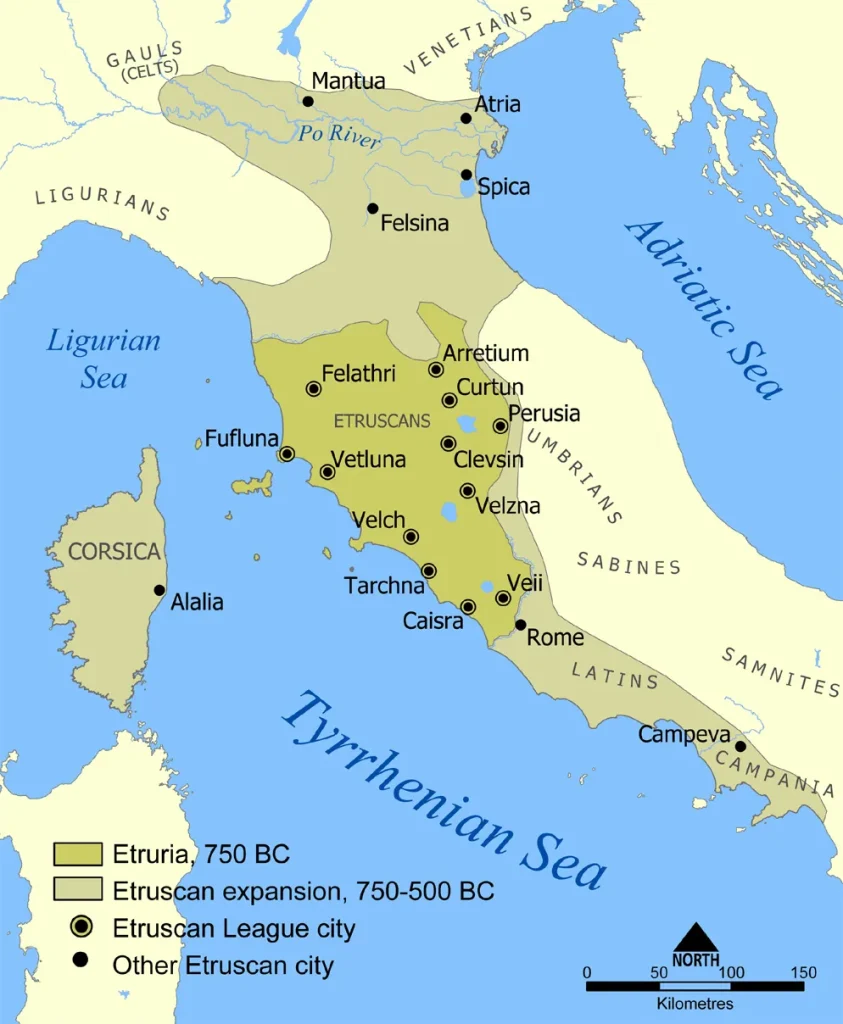
Vividly painted figures recline at banquets, while prancing musicians fill the air with cheerful tunes on double flutes. A cast of characters imbibes and enjoys the domestic spaces of the home. But where are we, and what are we witnessing?
This scene unfolds in the sixth-century BCE necropolis of Tarquinia–located fifty miles (eighty kilometers) northwest of Rome. Tarquinia (Etruscan Tarch’na) was once a powerful city-state of the Etruscan League where approximately six thousand graves are carved into the tufa hillsides. The tombs are opulent, adorned with wall paintings that unexpectedly celebrate life. They depict a vibrant realm filled with mystical creatures—leaping dolphins, gliding birds, and bearded serpents—accompanied by jugglers, musicians, dancers, and hunters engaged in festive banquets–-all breathing life into one of the most mysterious of ancient necropolises.
Today, if the Etruscans are considered at all, it is for their funerary monuments; they have endured the ravages of time. Was this civilization, recognized for its banquets and celebratory feasts that are brightly depicted on the walls of their necropolises, obsessed with the notion of death? Or is it simply that their funerary culture survives at the expense of their richly lived one? How might our understanding of the Etruscans differ if their writings and buildings had survived as well as their tombs?
The Etruscans are virtually voiceless in the world today because of the dominant influence of the Greeks in Western history and especially, the far-reaching grasp of the Romans. How then can we learn about the Etruscans when the often unforgiving forces of history have silenced them?
Although they had temples in honor of their deities, no Etruscan temple survives intact. Much like most of their building structures, the upper portions of their temples were made of impermanent materials such as wood and sun-dried brick. And unlike their Greek and Roman counterparts, the Etruscans left no surviving historical, mythological, or literary narrative works. While intentional cultural obliteration plays a significant role in the scarcity of literary works, the fact that their stories were frequently recorded on perishable materials, such as linen books and wax tablets, also contributes to this scarcity. Thus, the only narrative accounts we have about the Etruscans come from ancient Greek and Roman sources, which carry their inherent biases.
But before examining what Etruscan funerary artifacts may reveal about this lost civilization, it is necessary to consider who the Etruscans were and what became of their civilization.
Sphere of Influence
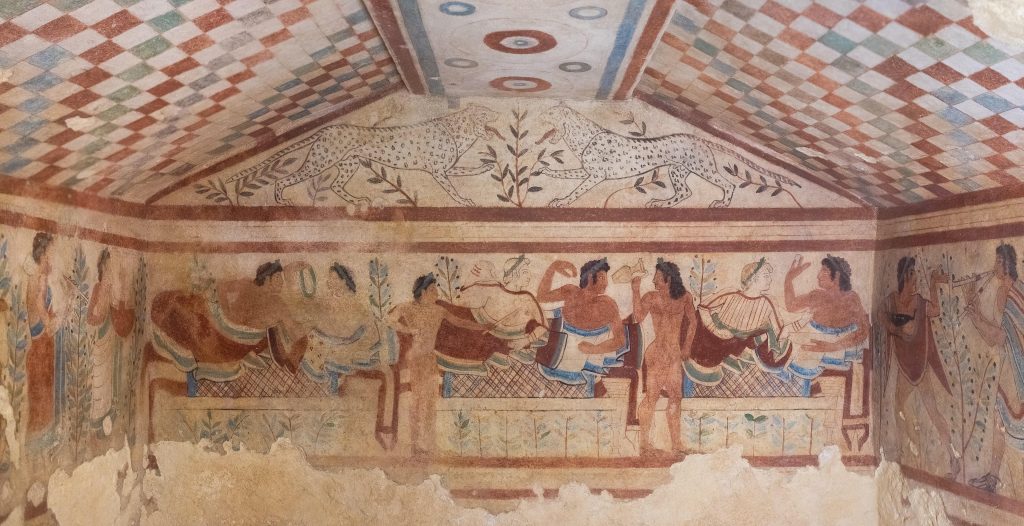
One of the few aspects we can affirm with confidence about the Etruscans is the indelible impact they left in the regions they inhabited. They were situated primarily between the Tiber and the Arno Rivers, in the area known as Etruria—west and south of the Apennine Mountains in today’s Tuscany, western Umbria, and northern Lazio. There the urban civilization flourished from the eighth to the first century BCE, until they were absorbed into the Roman Empire. With an expanding base that included settlements reaching north into the Po Valley and south into Campania, the Etruscans became a preeminent cultural and political power not only in Italy, but throughout the Mediterranean.
Their rich agricultural land, extensive mineral resources, and advanced manufacturing capabilities stimulated a flourishing economy, especially during their peak prosperity from the eighth to the fifth century BCE. Throughout this period, Etruscan city-states exerted control over mines, harbors, and commercial pathways connecting central Italy with the Greeks, Phoenicians, Sardinians, Celtic tribes situated north of the Alps, and other Italic groups. But in the space of a few hundred years, with Rome nipping at their heels, their civilization would go into deep decline.
Emperor Claudius on the Etruscan
s
The Romans wrote more about their beleaguered neighbor than any other ancient source. Indeed, Emperor Claudius’ (10 BCE–54 CE) Tyrrhenika is thought to have been the most authoritative work on the Etruscans. Although it was written in Greek, Claudius had married an Etruscan and was also fluent in the Etruscan language. As evidence of the status it received in the ancient world, Suetonius records that Tyrrhenika was read in Alexandria, the Greco-Roman center for academia. Sadly, like much of the Etruscans’ material legacy, this twenty-volume opus is lost to us. While ancient historians recorded and referenced Tyrrhenika, no copies or fragments have survived. Declining interest in the Etruscan civilization over the millennia may be a factor in the disappearance of the twenty-volume opus, as well as haphazard transmission methods. This loss underscores the fragility of cultural heritage and the challenges faced by historians in piecing together the narratives of ancient societies.
In Their Own Words
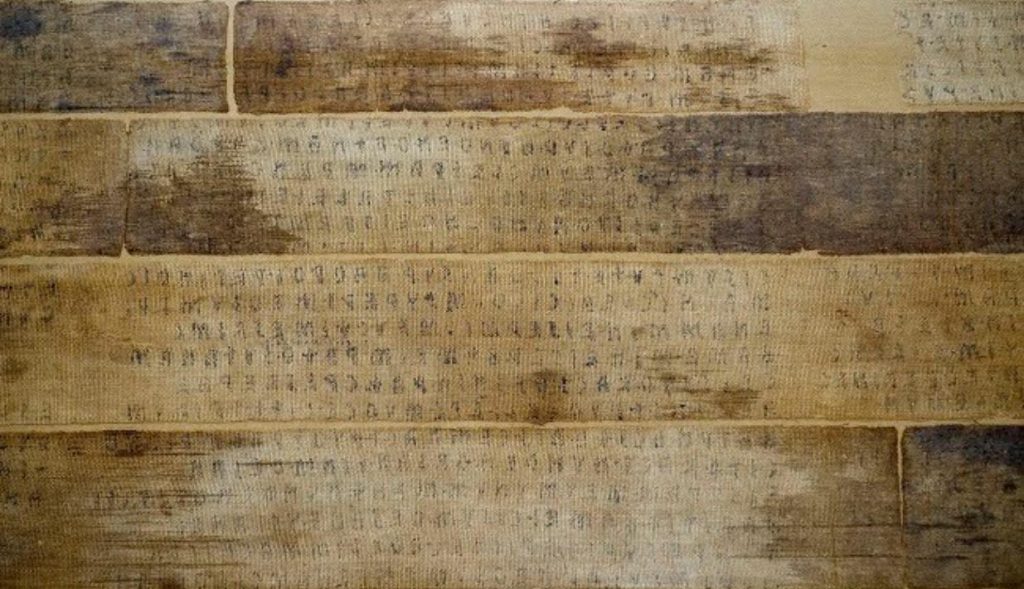
So what insights did the Etruscans provide about their own identity? The longest surviving Etruscan text (of about 1200 words) comes to us accidentally from a 19th-century collecting incident. The repurposed wrappings used on an ancient Egyptian woman known as the “Zagreb Mummy” inadvertently preserved this impressive work. Originally composed on linen cloth, the Liber Linteus (Linen Book) is especially important because it demonstrates that the Etruscans possessed sustained written ritual traditions.
Unlike Greek and Latin, Etruscan is not Proto-Indo-European and to this day is not fully translatable. The Etruscans wrote from right to left, and the body of text appears to be a ritual calendar, specifying occasions, offerings, prayers, and religious rites.
When the Liber Linteus was being transcribed between 200 and 150 BCE, the Etruscan language was already in a steady decline. That a religious calendar could have been used as recycled waste for the wrappings of an Egyptian mummy speaks volumes about the increasing insignificance of the once respected Etruscan culture and language.
Objects for the Living and the Dead
Today the only surviving Etruscan cities are those of the dead. This is because their buildings were constructed from wood, mudbrick, plaster, thatch or tile that were vulnerable to the effects of weathering and Rome’s subsequent transformations. The funerary culture has survived remarkably well for the Etruscans not only because the artifacts are more durable–engraved into rock and cut from stone— but also because some of the earliest tombs (tumuli) were built to last for several generations by the wealthiest residents. These necropolises offer invaluable insights into Etruscan life, beliefs, and societal structure. The elaborate frescoes and intricate grave goods found within these tombs reflect a rich cultural heritage that continues to captivate historians and archaeologists alike.
Since the Etruscans decorated their tombs with objects drawn from their lives, we know more about how the Etruscans lived from the intricate homes of their dead. Compared to the famously grim portrayal seen in the Hades of the Greeks or Rome’s underworld, life continued into the next world for the Etruscans, who viewed death as a means of maintaining continuity with an active social life. Several examples of Etruscan funerary art and burial practices illustrate why Etruscans believed that death was a continuation of life.
Instead of merely serving as locations for interred remains, the Etruscans often buried their dead in tombs designed to resemble homes, emulating residential spaces. Moreover, the Etruscans furnished their dead with objects and images from daily life. Their tombs housed individual adornments, recreational items, dining vessels, and occasionally even food, implying that the deceased were expected to persist in relishing the pursuits and pleasures they experienced during their lifetime.
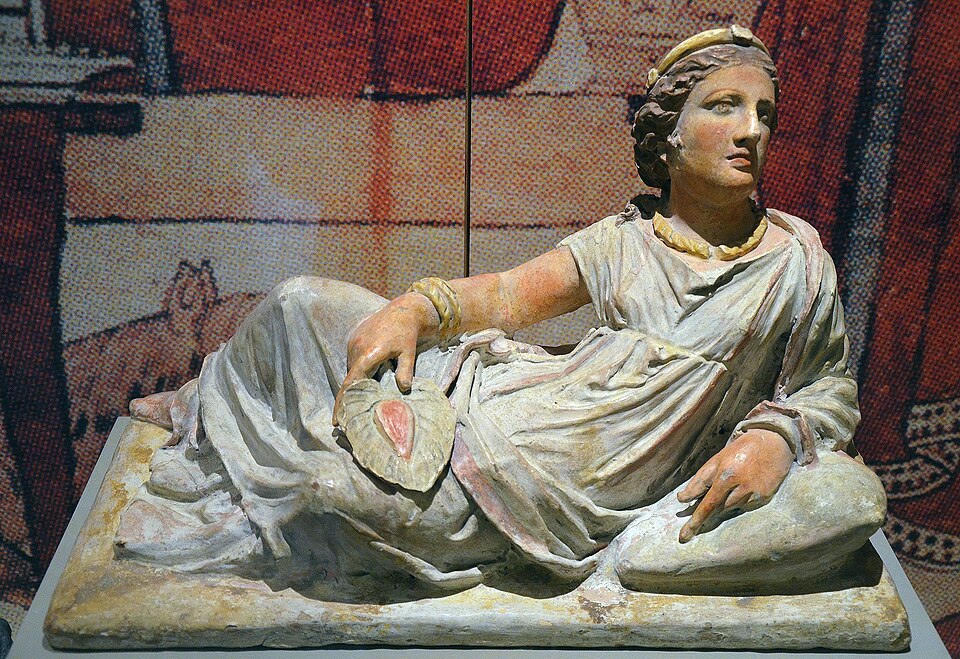
Illustrating feasts, music, dancing, and festivities, the sarcophagi and burial urns often depict the departed in a reclining position—- similar to banquet guests——linking the deceased with the communal joys of the living.
Despite the celebratory display of extravagant tombs, it is important to remember that they may disproportionally represent the wealthy. The poor and enslaved classes could not indulge in such luxuries in their afterlives. Moreover, funerary imagery may express an ideal rather than ordinary experience. The artwork might offer what some Etruscans sought to display rather than how they may have lived.
Neighborhood of the Dead
The belief that the Etruscans viewed death as a continuation of life is reflected not only in the elaborate and lively nature of their tombs but in the way they designed their necropolises. In Banditaccia (a UNESCO World Heritage Site), in the ancient city-state of Caere (today’s Cerveteri), thousands of the dead could count on more than just a gravesite. Due to a monopoly on the iron trade, Banditaccia was a bustling and prosperous metropolis that once boasted forty-thousand inhabitants, and so the necropolis includes over 2500 burials in thousands of tombs.
The most unusual aspect of the necropolis is that the streets and squares laid out for the dead resembled an urban center designed for the living. In the sixth century BCE, families gathered in the clearing outside the entrance of their ancestors’ multi-generational tombs both to honor their deceased ancestors and to enhance relations with each other. The event included a festive banquet where they shared a meal and revelry with the living as well as with the dead.
Etruscan Women
By far the largest surviving category of Etruscan writing is in their funerary inscriptions, which comprise ninety percent of Etruscans’ epigraphic corpus. Indeed, there are between ten thousand and thirteen thousand Etruscan inscriptions dating back from the eighth century BCE to the first century CE. This endurance is due to the more permanent nature of the artifact, as the inscriptions were cut, painted, or molded onto durable objects within tombs.
Typically the inscriptions are short; the deceased’s identity would be listed on the stone, as would their age of death and social or legal status. Along with a person’s name, the parentage was listed, including maternal descent.
Unlike many contemporary Greek and Roman epitaphs, noting maternal birth families on the tombstones may provide proof of the significance women played in society at large. Etruscan women were prominent in society and recognized participants, as evidenced in paintings depicting women reclining and drinking alongside men as equals in the banquet scenes. This was considered scandalous behavior in the contemporaneous Greek world where respectable married women were expressly forbidden to participate in the male dominated symposium (male drinking party). In fact, late Republic and Imperial era Roman women could thank their Etruscan counterparts for the convivium, Rome’s answer to the Greeks’ symposium. Unlike the symposium, the convivium allowed honorable wives into its gatherings.
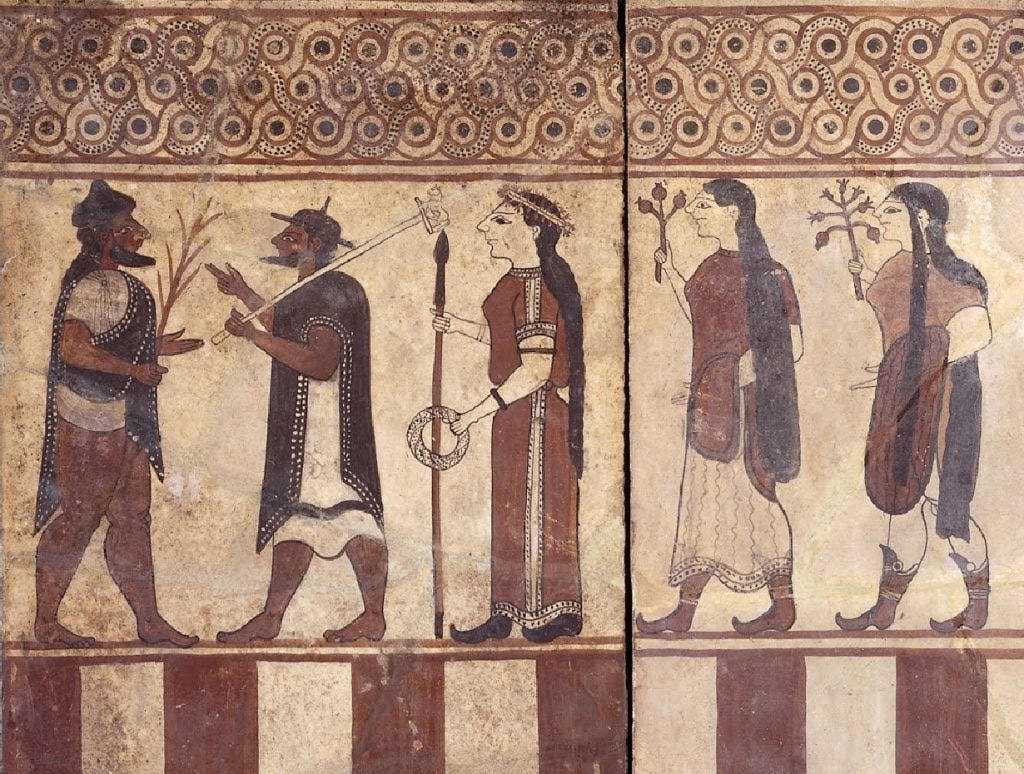
Fourth-century BCE Greek historian Theopompus of Chios famously reported on the audacious freedoms enjoyed by Etruscan women. Etruscan women, he claimed, were shared among the men, leading to uncertainty regarding paternity and communal child-rearing. Moreover, he bitterly complained about Etruscan women reclining on couches and dining with any men present—not just their husbands! According to him, they were skilled drinkers who boldly proposed toasts. He also noted that Etruscan women took excellent care of their bodies, engaged in sports either alone or with men, and felt no embarrassment about appearing naked in public. All of these Etruscan female attributes were considered shameful and disreputable to the Greek historian.
The Evolution of the Tombs
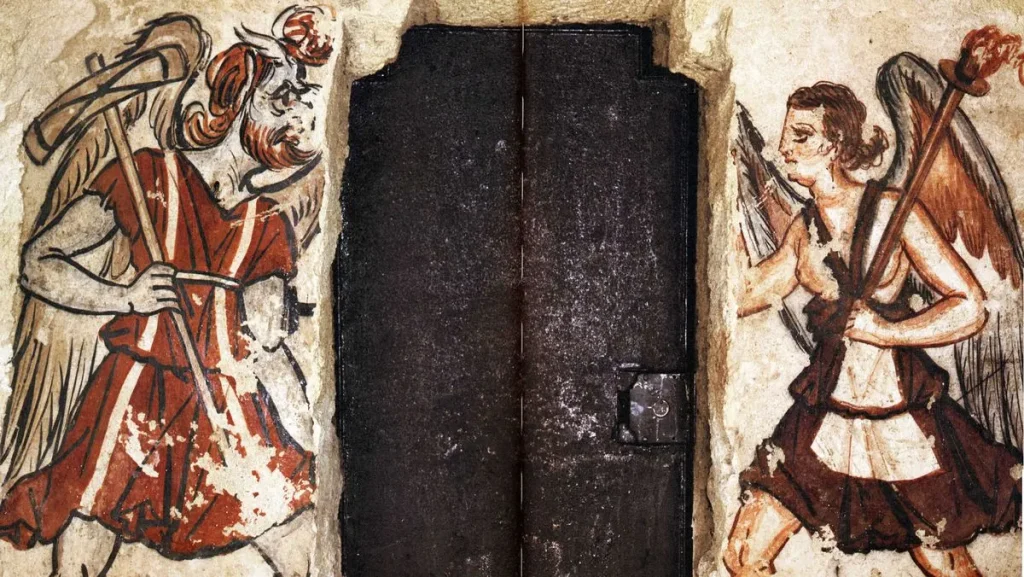
As their civilization experienced a downturn, from approximately the 4th century BCE onward, Etruscan funerary imagery shifted from pleasurable banqueting scenes to a marked preoccupation with the deceased’s journey into the underworld. The images were more soberly explicit and often resembled the Hades of the Greeks. Under the advancing stranglehold of the Romans, Etruscan communities began to have an increasing awareness of their mortality as well as the threat to their culture. The mood on the funerary artifacts changed from celebratory to somber.
Funerary images produced after this time focused more on encounters with otherworld guardians and guides rather than on pleasures connected with earthly life. The evolving imagery included numerous figures, such as Charun and Vanth, who, although terrifying, were not necessarily punishers, but could act as guides and protectors. Such scenes mark a change in how they perceived the transition from the living world to the world of the dead, with an increasing emphasis on supernatural aid and refuge.
Their downturn even affected funerary inscriptions. As Roman political and military power expanded, the Etruscan tongue would have to compete with the growing influence of Latin. This dichotomy or “linguistic coexistence” is demonstrated in the funereal inscriptions of many Etruscans, where the languages of the two cultures reside side by side on their tombstones. Rather than an abrupt replacement of one language by the other, there was a transition period in which Latin gained ground on the Etruscan language.
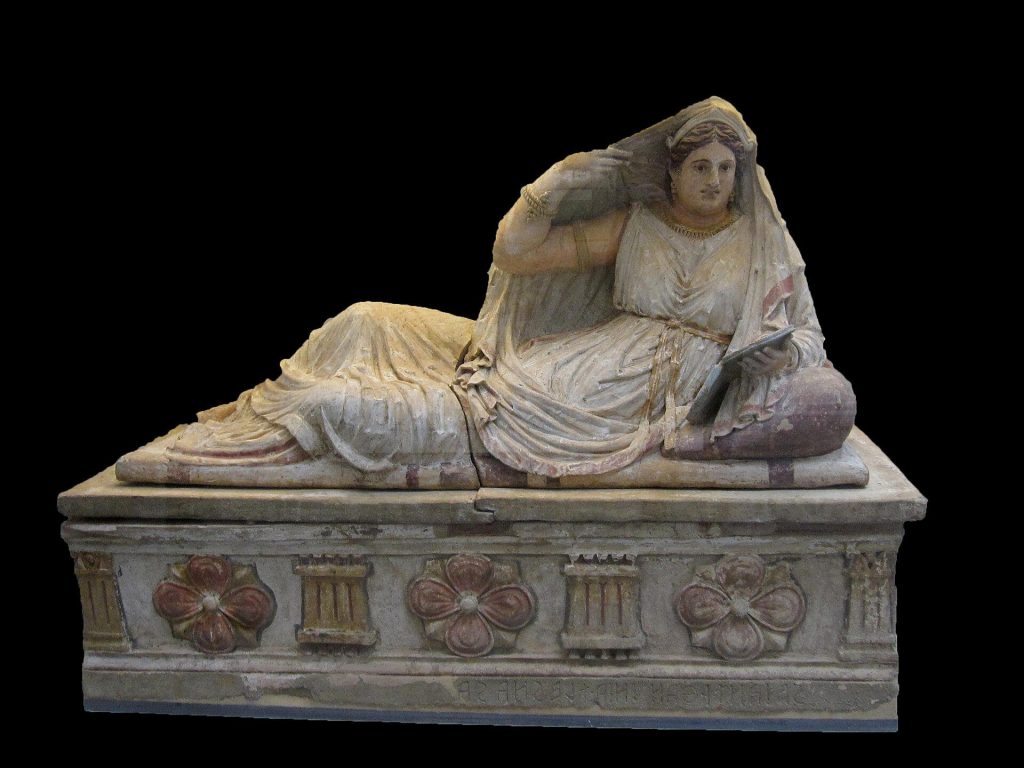
However, the adoption of Latin did not necessarily signify the disappearance of Etruscan cultural identity: Latin-language epitaphs could retain Etruscan naming conventions, while the burial urns themselves continued to follow established local traditions. Etruscan family identity continued even as the monuments recorded the increasing influence of the Romans.
Etruscan Influence on Rome
Rome could not merely erase Etruria from its collective memory. Although the first century BCE marked the end of Etruscan civilization, its influence would remain long after. Many of the innovations distinctly identified as Roman and for which Rome is celebrated, actually came from their vanquished neighbors from the north. The list is long and varied: notably, the city of Rome itself was once Etruscan, and the area known as the Roman Forum was drained when the Etruscans were in charge.
Under Etruscan kingship the significant sewer system in Rome known as the Cloaca Maxima (the greatest drain) was developed, allowing Rome to evolve from a loose collection of settlements into an urban center responsible for building aqueducts, roads, forums, temples, and civic spaces all by borrowing techniques used by their ill-fated neighbors. The Etruscans even provided the groundwork for Rome’s celebrated arch, which the Romans refined and expanded upon.
Although Rome may have militarily dominated Etruria, Etruria’s rich cultural legacy ultimately prevailed over its vanquisher. Their technical and cultural practices were passed on to the Romans from their unsung neighbors to the north paved the way for what would become an enduring cultural heritage that helped shape not only Roman identity but also the Roman Empire’s enduring impact on the Western world.
Funerary Culture versus Everyday Life
Despite the Etruscans’ cultural impact on Rome, how much of our perception of their identity would change if Etruscan writings and buildings had survived as well as their tombs? We would likely gain a more balanced view of their entire civilization, rather than relying solely on their burial practices and the writings of the Greeks and especially the Romans.
Although the tombs of the Etruscans will never restore their lost voices, the richness of the artistry displayed on their funerary monuments helps bring us closer to their enduring presence and the lives behind them.
Published on Classical Wisdom