Predominantly situated between the Tiber and the Arno Rivers—west and south of the Apennine Mountains—is the area known as Etruria (today’s Tuscany, western Umbria, and northern Lazio), whose urban civilization flourished from the eighth to the first century BCE when they were absorbed into the Roman Empire. The Etruscans became a preeminent cultural and political power in Italy and throughout the Mediterranean, as their rich agricultural land, extensive mineral resources, and advanced manufacturing capabilities stimulated a flourishing economy, especially during their peak prosperity from the eighth to the fifth century BCE. Throughout this period, Etruscan city-states exerted control over landmines, harbors, and commercial pathways connecting central Italy with the Greeks, Phoenicians, Sardinians, Celts (tribes situated north of the Alps), and other Italic groups. But in the space of a few hundred years, with Rome nipping at their heels, their civilization would go into deep decline.
The dominant influence of the Greeks in Western history and especially the far-reaching grasp of the Romans has often obscured the importance of the Etruscans in the ancient world, rendering them virtually voiceless in the world today. Unlike their Greek and Roman counterparts, there are no surviving historical, mythological, or literary narrative works from Etruria. History, after all, is written by the victors. While intentional cultural obliteration plays a significant role in the scarcity of literary works, so does the fact that their stories were frequently recorded on perishable materials such as linen books and wax tablets. Thus, the only narrative evidence we have about the Etruscans is from ancient Greek and Roman sources with their inherent biases. The surviving physical written materials from the Etruscans themselves are fragments, especially thousands of archaeological inscriptions found on their tombs and funereal stoneware.
How can we learn about the Etruscans when the often unforgiving forces of history have silenced them? From where did the Etruscans originate, who were they, and where has this enigmatic civilization gone? Although we know where they predominantly resided, the details of how the Etruscans lived remain a topic of some debate to this day.
Etruscan Origins
In an origin story passed down from Herodotus (484-425 BCE), the Greek purported “father of history” wrote that the Etruscans came from Lydia, in western Asia Minor (in today’s Turkey). He argued that as a result of a long famine Lydia’s King Atys divided the people into two groups. One group stayed in Lydia, while the other half—led by the king’s son Tyrrhenos—emigrated to Smyrna using ships that sailed westward. The migrants called themselves the Tyrrhenians—named after the king’s son—and eventually settled in the area known as Umbria. The Greek historian Strabo and many Roman writers, including Horace, Ovid, and Virgil supported Herodotus’s theory.
However, in the 1st century BCE, Dionysus from Halicarnassus challenged Herodotus’s account, instead contending that the Etruscans were “autochthonous” (springing from the land itself), meaning they were indigenous to the region. Because language is a key determiner of cultural identity, one of the chief factors Dionysus used to support his theory is that the Etruscans don’t use the same language as the Lydians.
 Contemporary analysis of Dionysus’ theory has determined that the Etruscan language is non-Proto-Indo-European. Unlike Greek or Latin or Anatolian (Lydian), which all descend from Indo-European, the Etruscan language is considered a “language isolate” with no proven genealogical relationship to any surviving language family in the world with no modern descendents since Latin eventually replaced it. The closest known cousins of Etruscan are the extinct dialects of ancient Raetic in the eastern Alpine region and Lemnian in the northeast Aegean, not any modern language.
Aside from language, Dionysus argued that the Etruscans retain none of Lydian’s customs, religion, or mythologies. An alternative explanation he offered for the word “Tyrrhenians” comes from the word the Etruscans used for towers or fortresses. Dionysus concludes that the Etruscans are a distinct and unique culture and one that is extremely old even by ancient standards.
Although earlier genetic studies were tentatively interpreted as supporting Herodotus’s account of a connection between Anatolia and Etruria, more recent genome-wide analyses of ancient Etruscan individuals do not support a large-scale migration from Anatolia to Etruria during the Iron Age. Instead, the majority of archaeologists today agree with Dionysus’s theory, that the Etruscans primarily evolved from indigenous Italian groups that exhibit genetic continuity, rather than migrating en masse from Lydia or Anatolia.
The Etruscans, however, traced their archaeological lineage back to the prehistoric later Bronze Age/Early Iron Age Proto-Villanovan culture, named after a region in Bologna, which existed from 1200 to 900 BCE and would develop into the early Iron Age Villanovan culture (900-700). The Villanovan communities laid the archaeological groundwork for Etruscan urban civilisation which would begin in around 800-700 BCE. It is important to note that the term “Villanovan” refers to an archaeological classification rather than a genetically uniform group. Archaeological artifacts from the Villanovan culture indicate substantial continuity between the Villanovans and the later Etruscans.
The Villanovan communities practised cremation, which has complicated efforts for archaeologists to obtain DNA sequences, since cremation largely destroys DNA. Though many experts believe that the Villanovan culture originated on the Italian peninsula due to cultural coherence with neighbouring Italic communities, the genetic characteristics of the Villanovan people remain mostly unknown, hindering experts from conclusively determining their place of origin.
The Romans on the Etruscans
The Greeks provide us with origin theories about the Etruscans, whom they called the Tyrrhenians, but it is from the Romans— their neighbors and conquerers—-that we learn the most about them. Although written over five hundred years after the events, in the fifth book of his 142 volume work Ab Urbe Condita (Founding of the City), Livy (Titus Livius 59 BCE-17 CE) discusses the downfall of Veii, one of the most affluent of the twelve Etruscan city-states, only ten miles or sixteen kilometers, northwest of Rome.
Livy depicts the Etruscan League as a pan-Etruscan consortium of twelve city-states that were unified by language, culture, and religious practices but argues they were not allied militarily. The Etruscan system of governance was entirely decentralized and governed independently within each city-state, in contrast to Rome’s governance, which was centralized and emanated from Rome as its core. According to him, the Etruscan city-states did not unite behind Veii because they did not approve of their king, whose political and religious conduct estranged the other members. When Veii appealed for help from the consortium, the other Etruscan communities refused; Veii was then left to face Rome largely alone and fell in 396 BCE. Livy paints their defeat as due to illegitimate kingship, sacrilegious offense, and a fragmented military and civic governance.
In other volumes of his work, Livy examines Rome’s Etruscan monarchs associated with the Tarquin lineage. In his concluding examination, Livy asserts that the last three Roman monarchs were of Etruscan descent and characterizes the monarchs as despotic opining that their oppression ultimately resulted in the collapse of the monarchy and the rise of the Roman Republic. The tyrannical nature of the Etruscan monarchs may help explain Rome’s long-standing disdain of monarchy.
Cicero (106 BCE-43 BCE) is another Roman who wrote about the Etruscans. In his book De Divinatione On Divination, he explores their sacred, religious, and divinatory book of rites that helped the Etruscans explain the will of the gods. The Romans called the Etruscan work Etrusca Disciplina, but the original Etruscan translation of its title has not survived the ravages of time.
The Etruscans’ ability to predict the future was legendary among Romans. Even the sybil who warned Julius Caesar about the Ides of March is said to have been of Etruscan descent. Cicero notes that the Romans considered Etruscan divinatory knowledge authoritative enough to seek the counsel of haruspices (“those who observed entrails of sacrificed animals”), as well as signs from lightning and other marvels on issues within the public sphere.
Cicero’s book is organized into two volumes. In volume one, his younger brother supports the practice of divination, while in volume two, Cicero is skeptical of its plausibility. The dialog between the two brothers reflects a conflict within late Republican Roman society: conventional state religion and its Etruscan divinatory specialists garnered political esteem, but intellectual detractors contested their assertions of truth.
Beyond Livy and Cicero, the single most authoritative work from a Roman was titled Tyrrhenika (Etruscan History)—a twenty-volume discourse written in Greek by the Emperor Claudius, who had married an Etruscan and was also fluent in Etruscan. To provide an idea as to the respect it garnered, Suetonius records that it was read in Alexandria—the Greco-Roman center for academia. Unfortunately for posterity, it has not survived. While the negligence of ancient authors toward the Etruscans could be blamed for the dearth of information we have about their civilization, this time it was because the texts and manuscript traditions that were meant to safeguard the work had in fact made it more perishable.
Roman writers from Varro and Virgil to Pliny the Elder, Seneca, Tacitus, and Servius each preserved a bit of Etruscan history, ritual expertise, cultural practices, and local traditions in their works—demonstrating that even after Rome conquered Etruria politically, the Etruscans remained a powerful presence in Roman memory and culture.
In Their Own Words
But what did the Etruscans have to say about themselves? Even though their literary works have not survived, the longest surviving Etruscan text (of about 1200 words) comes to us accidentally from a 19th-century collecting incident. The repurposed wrappings used to preserve an ancient Egyptian woman known as the “Zagreb Mummy” also inadvertently preserved the longest surviving Etruscan text we have to date. Originally composed on linen cloth, the Liber Linteus (“Linen Book”) is especially important because it demonstrates that the Etruscans possessed sustained written ritual traditions. Unlike Greek and Latin, Etruscans wrote from right to left, and the body of text appears to be a ritual calendar, specifying occasions, offerings, prayers, and religious rites.
One of the translated segments of Liber Linteus refers to a specific date of September 26th; most likely a cultic observance or sacrificial rite. The segment reads that gifts should be given to the sea god, Nethyns (Roman Neptune) and the offerings should be of wine. Like most ancient religious texts, the book would have organized the lives of the Etruscan community naming the seasons and the festivals pertaining to them that would ensure a healthy, vibrant, and long life.
The script has been largely deciphered; however, as a “language isolate,” the Etruscan language—its vocabulary and grammar—remains only partially understood. As previously mentioned, unlike Greek and Latin, Etruscan does not belong to the Indo-European language family. Nevertheless, the scripts themselves of the Greeks, Etruscans, and Romans evolved from one another. The Greeks had previously adopted and adapted the Phoenician script, while the Etruscans utilized the western variant of the Greek alphabet. Due to close contact with the Romans, the Etruscan writing system contributed to the development of other Italic alphabets, including Latin, in which twenty-one of the twenty-six letters have Etruscan origins.
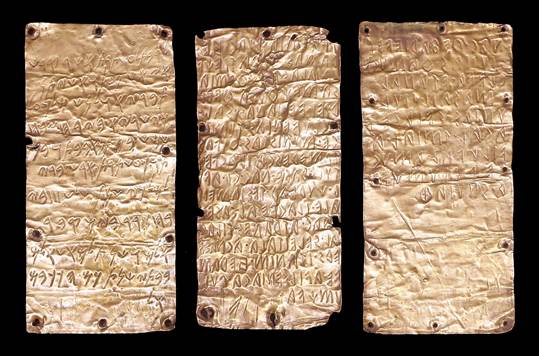
Another archaeological discovery from the Etruscan port town known as Pyrgi (in the ancient city-state of Caere, today’s Cerveteri) has helped shed light on the enigmatic Etruscan language. Pyrgi was an international hub that allowed commercial, diplomatic, and religious interactions with the Phoenicians, particularly the Carthagenians. Three golden tablets were found covered in the script of two languages: Phoenician and Etruscan. Unlike the Etruscan language, the Phoenician language is largely translatable. The finding, dating back to around 500 BCE, is important because the two inscriptions are related in terms of context; they are bilingual proclamatory texts nailed to the walls of the port’s sanctuary complex. Although they may not be literal translations the meaning of the two is similar. Thus reading the Etruscan side by side with the Phoenician has given linguists clues about meaning within the Etruscan language.
The dedicatory text reads: “For the Lady, for Astarte: this sacred place was made and given by Thefarie Velianas, who rules over Caere.” Astarte is the goddess of fertility in the Phoenician pantheon; in Etruscan the goddess was known as “Uni.” The leader, Thefarie Velianas, wants to make clear that he is dedicating a sanctuary to the fertility goddess and it specifies a date for the event. That there was a bulletin for all to read in Pyrgi indicates that the people were largely literate in Etruscan but that would soon change.
Following the defeat of the Etruscan forces by the Greeks in the battle of Cumae in 474 BCE, Etruscan control of Campania became unsteady; trade routes were broken, and the prosperity of the Etruscans was under siege. Not long after, in the early fourth century BCE, upstart Rome began to flex its military muscle, and the Etruscan tongue would compete with the growing influence of Latin. This dichotomy can be seen in the funeral inscriptions of many Etruscans, where the languages of the two cultures reside side by side.
When the Liber Linteus was being transcribed between 200 and 150 BCE, the Etruscan language was already in a steady decline. That a religious calendar could have been used as recycled waste for the wrappings of an Egyptian mummy speaks volumes about the increasing insignificance of the once respected Etruscan culture and language.
Prevalence of Funereal Culture
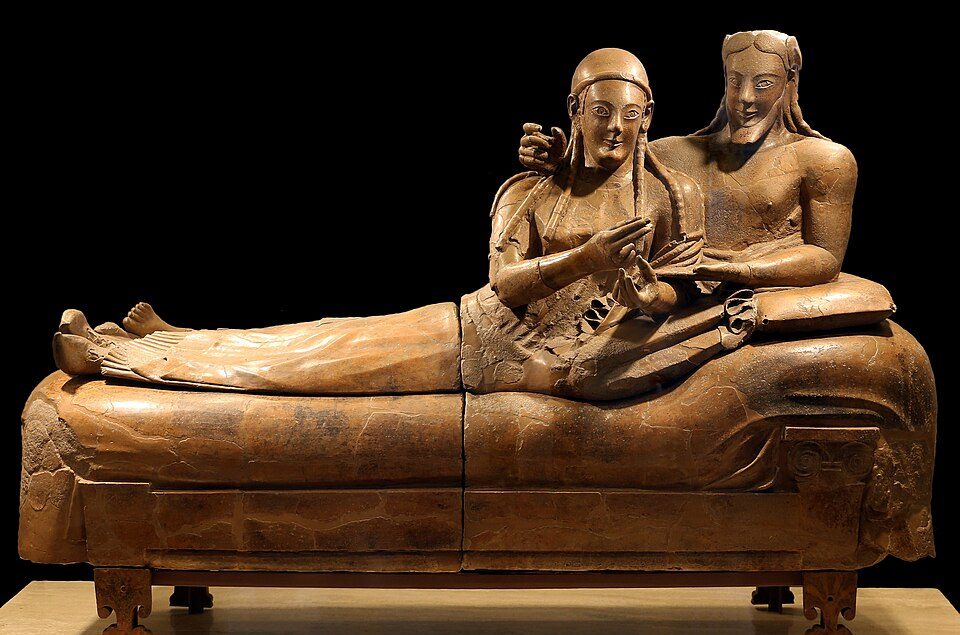
By far the largest surviving category of Etruscan writing is in their funerary inscriptions where they comprise fully ninety percent of Etruscans’ epigraphic corpus. This endurance is due to the more permanent nature of the artifact as the inscriptions were cut, painted or molded onto durable objects within tombs such as sarcophagi, cinerary urns, stone stelae, tomb walls, and grave goods.
There are between ten thousand and thirteen thousand Etruscan inscriptions dating back from the eighth century BCE to the first century CE. Typically the inscriptions are short; the deceased’s identity would be listed on the stone as would their age of death and social or legal status. Along with a person’s name, the parentage was listed, including maternal descent. Unlike many contemporary Greek and Roman epitaphs, noting maternal birth families on the tombstones may provide proof of the significance women played in society at large.
Engraved into rock and cut from stone, the funereal culture has survived remarkably well for the Etruscans not only because the artifacts are more durable but also because some of the earliest tombs (tumuli) were built to last for several generations by the wealthiest residents. While their homes, temples, and public buildings were constructed from wood, mudbrick, plaster, thatch, or tile and were vulnerable to the effects of time, weather, and Rome’s subsequent transformations, today the only surviving Etruscan cities are those of the dead.
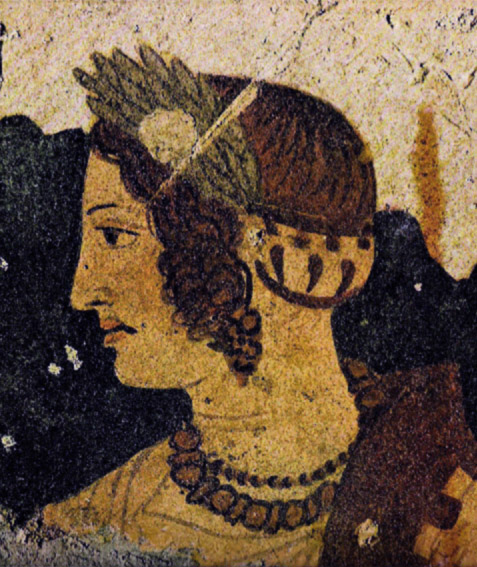
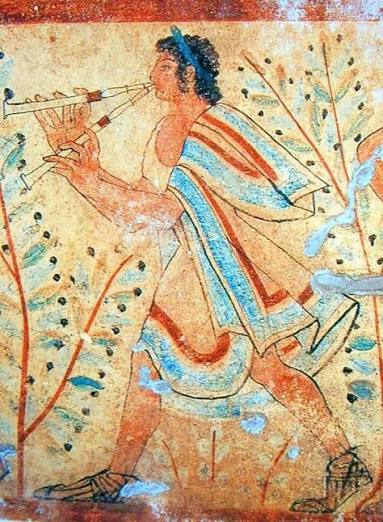
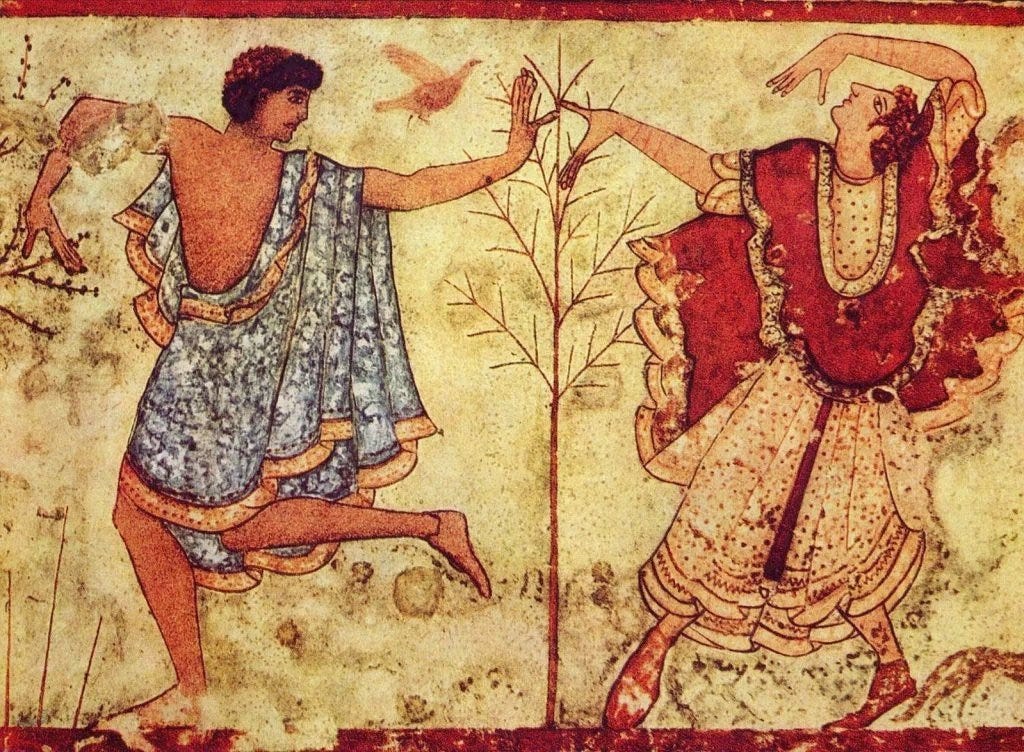
The sixth-century BCE necropolis of Tarquinia (in a principal Etruscan city/state of ancient Tarquinii) is notable for its well-preserved, vividly colored depictions of humans and animals on their funereal walls. The tombs are both grandiose and opulent, with wall paintings that carry an unexpected zest for life depicting banquets and drinking parties, music and dance, sports displays, and hunting and fishing settings.
Etruscan Women
Besides inscriptions of the maternal line on tombstones, another indication that Etruscan women had more agency in their lives than their Greek counterparts is the paintings depicting women who participated as equals in the banquet scenes, reclining and drinking alongside men. This would have been considered scandalous behavior in the contemporaneous Greek world where respectable married women were expressly forbidden to participate in the male dominated symposium (“male drinking party”). In fact, late Republic and Imperial era Roman women could thank their Etruscan counterparts for the convivium, Rome’s answer to the Greeks’ symposium. Unlike the symposium, the convivium allowed respectable married women into its gatherings.
Judging by their grave goods women were prominent in society and recognized participants in both family status and especially aristocratic social life. Their tombs often highlighted wealth, ancestry, banqueting, and partnerships with men in a forthright manner.
How they Lived and How they Died
The elaborate and lively nature of their tombs suggests that the Etruscans viewed death as a means of maintaining continuity with an active social life compared to the famously grim portrayal seen in the Hades of the Greeks or Rome’s underworld equivalent. For the Etruscans, life continued into the next world; the tombs resembled houses and provided burial furniture, benches, and platforms with carved beds. The necropolis appears to have been a liminal space between the living and the dead and full of terrestrial energy.
As their civilization experienced a downturn, approximately in the fourth century BCE and reaching its peak in the first BCE, the lively designs of their tombs evolved into more sinister representations of the Underworld, inhabited by demons and other malevolent entities, more like Hades of the Greeks.
Today, if the Etruscans are considered at all, it is for their funerary monuments, which have endured the ravages of time. Was this civilization recognized for its banquets and celebratory feasts—vividly depicted in their landscape paintings that adorn the walls of their necropolises—obsessed with the notion of death? Or is it simply that their funerary culture survives at the expense of their richly lived one? As with much else about the Etruscan world, this continues to be a subject of contention to this day.
Despite their hapless fate, where did the Etruscans go? The answer is simple: they stayed. As Rome’s power surged, the powers of Etruria ebbed; alas, there was only room for one superpower in central Italy. Then, one by one, as Rome conquered their individual city-states, the Etruscans became politically subjugated under the iron thumb of Roman rule, eventually assimilating into the Roman state. The years 90-89 BCE signify the complete legal incorporation of Etruscan communities into the Roman body politic. But the Etruscans’ language, culture, and religious traditions persisted into the late Roman Republic and early Roman Empire and much beyond….
What the Etruscans Gave the Romans
Rome could not merely erase Etruria from its collective memory. Although the first century BCE marked the end of Etruscan civilization its influence would remain long after. Many of the innovations distinctly identified as Roman and for which Rome is celebrated actually came from their vanquished neighbors from the north. The list is long and varied and the examples below are just a few of the many advances that the Romans adopted from the Etruscans. Notably, the city of Rome itself was once Etruscan, and the area known as the Roman Forum was drained when the Etruscans were in charge.
Items such as the purple bordered toga, the fasces—a symbol of the iron will of state power used to this day—Roman religion (especially in the realm of divination), the famed Roman numerals—which evolved from tally marks carved into wood, bone, or stone. Rome’s celebrated atrium, tiled roofs, various civic rites and regalia showcased in the Roman Triumph, and gladiatorial contests— which were adopted (and adapted) from Etruscan funerary practices. Even the word for “person” (phersu) can be credited to the Etruscans.
Moreover, the Etruscans were crackerjack engineers. Under Etruscan kingship the significant sewer system in Rome known as the Cloaca Maxima (“the greatest drain”) was developed, allowing Rome to evolve from a loose collection of settlements into an urban center responsible for building aqueducts, roads, forums, temples, and civic spaces all by borrowing techniques used by their ill-fated neighbors.
The Etruscans even provided the groundwork for Rome’s celebrated arch, which the Romans refined and expanded upon.
Although Rome may have militarily dominated Etruria, Etruria’s rich cultural legacy ultimately prevailed over its vanquisher. The engineering, architectural, cultural, and religious practices that were passed on to the Romans from their unsung neighbors to the north paved the way for what would become an enduring cultural heritage that helped shape not only Roman identity but also the Roman Empire’s enduring impact on the Western world.