With a penchant for turning men into swine, it is no wonder that Circe is having a moment right now. In Christopher Nolan’s blockbuster film adaptation of the Odyssey, Circe is portrayed as a seasoned witch who fears that Odysseus’s crew have dangerous intentions toward her; thus, she poisons them with her gristly stew. Then, one by one, as they gorge themselves on her slop, she plunges her hands into their throats and bone-crunchingly reshapes their faces and bodies into those of pigs—reflecting their gluttonous appetites…. and true natures.
In Madeline Miller’s book of the eponymous sorceress, Circe is a rape victim who practices divine retribution by turning all men who grace her secluded island into swine. But the seductive sorceress is originally best known for her nefarious role in Homer’s Odyssey, when she notoriously swinifies Odysseus’s crew—seemingly for no other reason than that she could.
Perhaps it was her royal lineage, which rose from the sun and the sea, that gave her license. Her father, after all, was a first generation Titan sun god Helios, and her mother, the overbearing Oceanid Perse, was the daughter of the Titan ocean god Oceanus himself. With royal blood coursing through her veins, who could blame Circe for being imperious? The Titans, it is important to remember, were the generation of gods that preceded the all-powerful Olympians. Finally, Circe is the berating aunt to Medea, the infamous divinely ordained serial murderer and sorceress. Given a family so magically endowed, it is not surprising that her talents surpass those of even the most exceptional of witches.
Long before the Odyssey was penned nearly three thousand years ago, Circe lived in the vivid imagination of the Greeks who were the first to lay claim to her, but they were not the last. But what are the many faces of Circe? And what might her mythologies represent in the cultures from which they sprang?
The Homeric Circe
Dating back to the eighth century BCE, Hesiod, in Theogony, bestowed upon Circe a royal lineage, but it was his contemporaneous poet Homer who gave her life. We first encounter Circe in his Odyssey, the epic poem that recounts the legendary tale of Odysseus’s ten-year protracted journey home to Ithaca from the Trojan war. When Odysseus and his men land on Circe’s island of Aeaea they are at one of their lowest ebbs. Eleven of their twelve ships have been destroyed by the Laestrygonian giants; because he was moored outside the harbor, only Odysseus’s ship and crew survive. When the grieving and exhausted men see smoke rising inland signaling a human dwelling, they draw lots and divide into two groups. Odysseus’s group stays behind, while Eurylochus leads the scouting party of twenty-two to locate the source of the smoke.
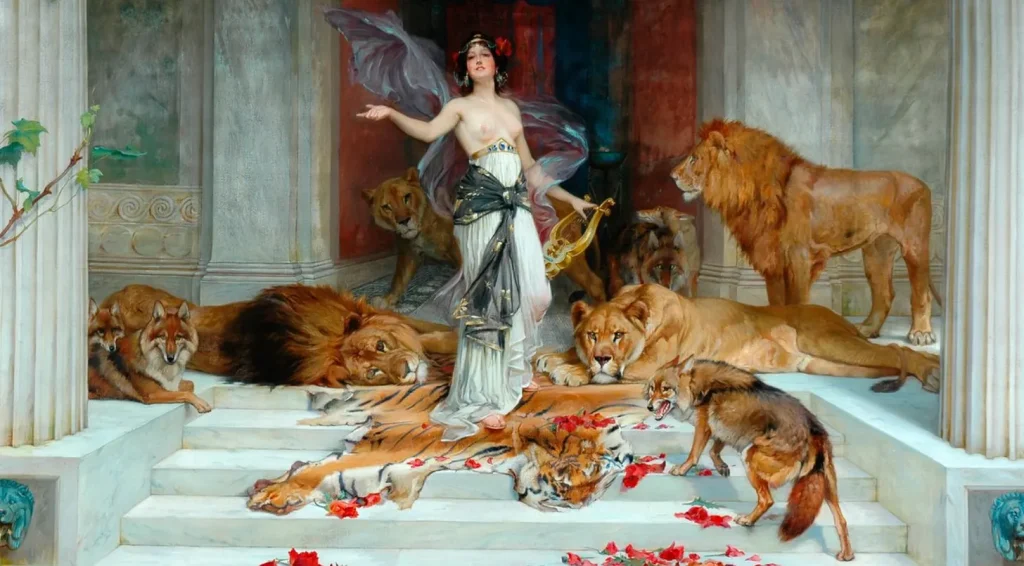
It does not take long before the scouts encounter bewitched lions and wolves that surround Circe’s stony fortress; the men are terrified as the creatures approach them, yet due to their enchantment, the animals wag their lengthy tails and exhibit affection toward the men, much as dogs do with their masters. Then the men hear melodic singing from the stone mansion: “They stood there in the forecourt of the goddess with her glorious hair and heard Circe singing in a sweet voice.”

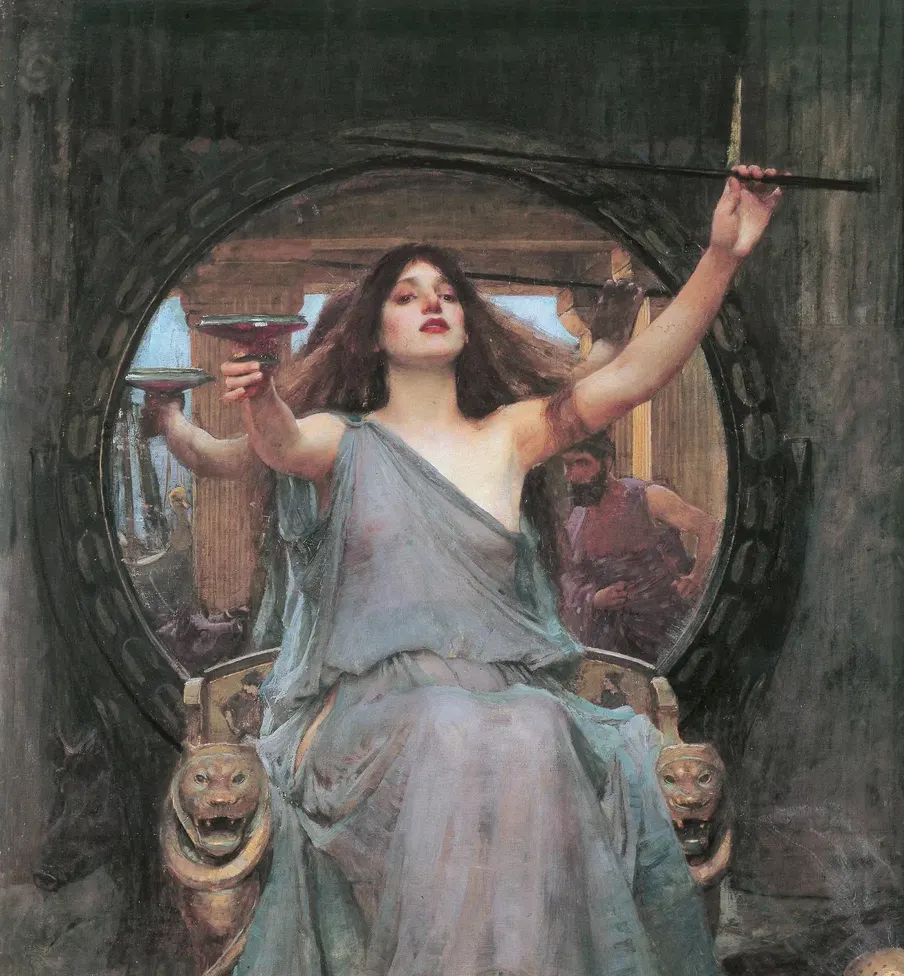
An inviting Circe opens her doors to the beleaguered men welcoming them into her homestead. All comply except for a skeptical Eurylochos who vigilantly remains outside. The men enjoy the repast she has prepared, but unbeknownst to them, the feast is poisoned with, “malignant drugs to make them forget their own country.”
Using her wand she transforms the crew into pigs and prods them into pig pens. In perhaps the cruelest part of the enchantment, though their bodies are transformed into swine, their minds remain intact fully aware of what has been done to them.
A recurring theme in the Odyssey is the Greek principle of xenia, which mandates that strangers should be welcomed, nourished, housed, and honored. This concept is sometimes recognized as Zeus Xenios, the god of strangers and guests. Xenia makes hospitality a sacred obligation as the host’s treatment of a stranger is a test of piety and social justice. After all, the stranger at your door could be a god testing you. Violating xenia was significant and a major breach in the sacred system of reciprocity. Circe is not alone in breaking the rules of hospitality central to the plot of the Odyssey, nor is she the last offender.
When Odysseus gets word about the disappearance of his crew, he sets out for Circe’s compound, but along the way, he encounters the messenger god Hermes who advises him to arm himself with moly— an herb that will help mitigate the sorceress’s spells. Hermes also instructs him that when Circe strikes him with her wand he should unleash his sword as if attempting to kill her. He says, “she will be afraid and invite you to go to bed with her.”
Finally— because she can’t be fully trusted—he advises Odysseus to have her swear “the oath of the great gods.” This will prevent her from going back on her word because taking such an oath is sacrosanct amongst the immortals. Doing as Hermes instructs, Odysseus’s aggression automatically tames the sorceress’s wild instincts and she becomes a pliable female who surrenders to his militant masculinity. From a “dread goddess” she is magically transformed into a helpmate; a woman who aims to please and fulfill his every wish.
The sorceress is not merely affectionate toward Odysseus and sympathetic to his cause; more importantly, of all the men who have arrived at her island retreat, he alone is permitted to retain his human form. She reveals to him: “The wonder is on me that you drank my drugs and have not been enchanted, for no other man besides you could have stood up under my drugs.” When Odysseus asks her to restore his companions, she readily complies, transforming them back into men who are healthier, younger, and better looking than before.
Odysseus is then coddled and pampered by nymphs in Circe’s stone palace where he and his crew suffer no lasting damage for their extended stay on Aeaea. Odysseus is so comfortable with his new surroundings that after a year his men have to remind him to leave the island and persist in their drawn out journey home to Ithaca: “What ails you now?” they ask, “It is time to think about our own country.” But before he and his men leave, Circe gives him instructions that he must visit Hades and meet with the blind seer Tiresias who knows the will of the gods and the future.
As a liminal figure who can cross the borders between this world and the next, Circe provides Odysseus explicit instructions on the path to Hades. In fact, of all the characters who help Odysseus in his struggle to return home, Circe is indispensable—even more helpful than the seer Tiresias—and offers the most detailed advice. Not only does she tell him to consult Tiresias and provides elaborate directions to the underworld, but she also warns him about the Sirens, explains the differing perils of Scylla and Charybdis, and cautions him not to eat Helios’ cattle on the island of Thrinakia.
As valuable as she is, like all autonomous females within the epic, Circe represents a figure who is a threat to male authority. Throughout the episode, a broader male unease with female power is reflected in the figure of Eurylochus—the sole crew member who remains apprehensive about the capricious Circe.
In a world where patriarchy serves as the epic’s foundation—and reflects the era from which the narrative is based—autonomous females challenge traditional gender roles and subvert the dominant paradigm. Time and again, the autonomous characters of Helen, Clytemnestra, Circe, the Sirens, Scylla, Charybdis, Calypso, and even, to some degree, Penelope, demonstrate that female authority is both formidable and wholly unpredictable, posing a danger to the foundational principles of patriarchal power that underpin the epic poem. That said, does the presence of independent women within the epic suggest that the ancient world was not as consistently patriarchal as commonly assumed?
Giving detailed instructions for his journey home is not the end of Circe and Odysseus’s legend. In Theogony, Hesiod gives the couple three sons: Agrius, Latinus, and Telegonus, all of whom rule the Tyrrhanians (Etruria—today’s central and northern Italy). In the lost epic, Telegony, Telegonus gains notoriety for accidentally killing his father, (Odysseus). He even weds Penelope while Telemachus marries Circe herself!
Circe in the Argonautica
In the next account, Circe plays a supporting role in the Argonautica by Apollonius of Rhodes (295-215 BCE). The epic poem tells the story of the Greek hero, Jason and the princess from Colchis, Medea (also Circe’s niece), whose invaluable support assists Jason in stealing the Golden Fleece. Their real troubles begin, however, when Jason and Medea murder Medea’s brother, Apystus. The act was not a military killing but a betrayal against kin through duplicity; Medea feigned a desire to meet her brother, only to set a trap for him. Zeus, the deity of purification, views the homicide as a grave contamination, necessitating that Jason and Medea consult the sorceress Circe—who lives beyond the bounds of the Greek world—for ritual purification.

In accordance with Zeus’s rites, Circe helps Jason and Medea, “expunge the deed’s contamination.” After sacrifices and ritual libations are offered to cleanse the couple, Circe questions her niece about their exploits in their native Colchian tongue. A shamefaced Medea does not confess to the murder of her brother, yet the all-knowing Circe deduces the crime. Predicting her niece’s future troubles, Circe exclaims, “Poor wretch! Look what a scandalous, obscene elopement you have devised…please leave my home and take this stranger (meaning Jason) with you!’”
Circe is once again inverting the paradigm; the “dangerous enchantress” is coming from a place of moral integrity, berating Jason, a Greek hero.
In this episode it becomes clear that the Greek hero is missing the moral authority that the ”barbaric” wise woman engenders. What is more, both Circe and Medea come from outside the Greek world and thus are deemed barbarians. As such, they are inherently regarded as uncivilized in contrast to the Greeks, yet it is the Greek hero who incites Medea’s transgressions. In the third century BCE, when Argonautica was penned, the division between Greek and non-Greek was topical. Greek culture was proliferating beyond its borders, frequently blurring the distinction between Greeks and non-Greeks as reflected in the narrative.
Moreover, in the Hellenistic period when Apollonius wrote, myths were often being reinterpreted. Thus, Circe has been transformed from a dark sorceress to a wise woman who has expertise in purifying ritual contamination caused by bloodshed—a significant issue during this period of intense conflict and nearly continuous warfare. Although danger lurks nearby in the form of the bizarre animals who populate her island, arrayed with a “medley of limbs,” Circe is depicted not so much as a threat but as a conventionally respectable wise woman; she offers specialized knowledge and insights that the Greek hero lacks.
The Circe of Virgil
The next time we hear from Circe, she is more symbol than persona with a role significantly reduced and no speaking part. Virgil’s Aeneid (29-19 BCE) is based on a foundational myth about the establishment of Rome by the Trojan hero Aeneas, who narrowly escapes the destruction of Troy and travels to Italy, where he becomes the progenitor of the Romans. Written during the dawn of the Roman Empire, the Aeneid was commissioned by Octavian (later known as Augustus) after his decisive victory at Actium (31 BCE) over Antony and Cleopatra.
As an enchantress from the East— analogous to Cleopatra’s perceived persona—Virgil purges the human and positive aspects of Homer’s sorceress and focuses on her supernaturally dangerous side. On a divinely ordained journey, Aeneas is unlike Odysseus, as he is a man with a mission to found an empire. Neptune (god of the sea) provides Aeneas and his crew with favorable winds so they never have to land on Circe’s island and can escape her treachery. Yet they sail near enough to hear her singing and the frightening cries of the animals who had once been men: “the furious growls of lions bridling at their chains, roaring into the dead of night…the men whose shapes the brutal goddess Circe changed with her potent drugs.”
Circe’s scene in Book Seven comes just before the outbreak of the Italian war in Book Eight. In this section, Aeneas’s shield depicts the Battle of Actium, illustrating Antony allied with Cleopatra and Egypt while opposing Augustus and Italy. Coming hard on the heels of the war between the two Roman adversaries, Virgil’s Circe symbolizes the seductive power of the decadent East and demonstrates how the hero successfully navigates away from its multi-faceted perils, triumphantly evading the danger that Augustan propaganda asserted had defeated Antony.
Ovid’s Circe
While Virgil’s Circe is remote and unseen, Ovid’s Circe is tangible and all too human. In his epic poem Metamorphoses, Ovid (43 BCE-17 CE) paints a wicked portrait of Circe as a sorceress endowed with supernatural abilities, but burdened with the human emotions of wrath and envy. Alas, Circe is the victim of unrequited love: “never heart more sensitive than hers to love’s assault.” Love’s assault compels her to execute savage revenge against those she perceives as her adversaries.
Firstly, there is the story of poor Glaucus, who began life as a fisherman but, after consuming an herb, is transformed into a handsome sea god, attracting the affection of Circe. But Glaucus has eyes for another, the comely sea nymph Scylla, who, regardless of Glaucus’ station and good looks, has no interest in him. So he petitions Circe for a love potion to induce Scylla to fall in love with him. Circe, however, has other intentions and tells Glaucus of her love for him: “Spurn her who spurns you; welcome one who wants you. By one act, requite us both!”
Glaucus then disappoints our dark maiden telling her, “I shall (never) change my love while Scylla lives.”
Because she has no interest in harming her beloved, she turns her wrath on the one he prefers and concocts a poison for the cove that Scylla loves to wade in. The credulous Scylla looks down and in place of her legs sees “monstrous barking beasts.” Poor Scylla, the more she tries to run from the intolerable beasts, the more she brings them along: “Her thighs, her legs, her feet, found gaping jaws instead, like Hell’s vile hound.”
A sobbing Glaucus breaks free from Scylla’s intolerable embrace. Until this day, the monstrous sea nymph remains in the Straits of Messina, where she can unleash her fury upon woeful sailors both past and present.
The next unfortunate object of her affections, is the legendary first king of Latinum, Picus. Young and handsome “he was the darling of the fountain sprites” but his heart belonged to his lovely wife, Canens, known for her beautiful voice. Often taking to the countryside to hunt boars, it was when he was on one such outing that Circe spotted the handsome regent: “she saw the young king—saw and gazed entranced…like blazing fire a thrill of ecstasy raced through her veins.”
Once again, Circe is in love. Breathing the earth’s vapors she lures him away from his courtiers and proclaims her undying love for him: “Loveliest of kings, that makes me here, a goddess, kneel before you, favour my passion…and harden not your heart to Circe’s love.”
But like Glaucus before him, Picus loves another and boldly tells her, “I am not yours; another holds my heart, and many a year I pray shall hold it.” Never one to go gently into the night, Circe pleads with the regent, but to no avail.
“You’ll pay for this,” she cries. “Now you shall know what one who’s wronged, who loves, who’s a woman too—and I that loving woman wronged—can do!” She sings a spell, and using her wand, she changes him into a woodpecker: “He’d fled and marvelled that he ran so fast – so strangely fast – then saw he’d sprouted wings!”
His courtiers comb the land for him but instead find Circe, whom they rightly hold accountable and brandish their spears. As usual, Circe had the final say and with her poisoned wand transforms them all into wild beasts. Searching for Picus for six days and six nights, Canens is beside herself with a grief that destroys her. She sings a woeful song by the banks of the Tiber River before fading into nature.
Circe’s power over life and death reflects the authoritarian times of the Augustan era in which Ovid lived. Although he was hardly chaste himself, Augustus enacted a series of strict moral laws (Leges Iuliae) designed to promote marriage, legitimate procreation and to regulate sexual conduct—especially among the upper classes. Just as Circe could transform her victims by mere incantation and high-handed resolve, likewise, Augustus exercised exceptional autocratic authority over his subjects, including the power to exile. Supposedly for moral transgressions, he exiled his daughter, his granddaughter, and his grandson—and exposed another grandchild—with no trial or due process under the law. And these were just his family members—all of whom would die in exile.
Ovid himself was a target of Augustus’s iron fisted practice of exile. Augustus’s strict moral laws would often clash with the poet’s salacious writing, which was one justification for Ovid’s banishment. Although Ovid and his family members wrote many heartfelt letters asking the emperor to pardon him, Augustus remained unyielding. Ovid outlived Augustus, but he did not outlive his exile; Tiberius continued his stepfather’s autocratic rule and refused to absolve him. Ovid would die in exile in Tomis (today’s Romania) in 17 or 18 CE.
Circe & Nature
In the ancient world, women embraced their connection with nature to become well-versed in medicinal plants and other natural healing remedies. It is this rich cultural heritage from which the mythologies about the sorceress Circe sprang. Though Circe may have been among history’s first scorned witches, she was by no means its last.
Moreover, while the myths and traditions cannot agree on the specifics, what remains constant is that she was an autonomous woman, yoked to no man, possessing profound knowledge of plants and herbs—a dangerous source of her power. With an ability to capriciously control nature and wield magic at will, Circe is a subversive figure who defies the dominant paradigm by brandishing her power over the lives of men. In modern interpretations, Circe is often recast as an icon of female empowerment, triumphantly reclaiming her story from history’s gloomy mists. Much more than Homer’s feared enchantress, Circe restores the feminine voice in mythology and endures as a force who was both formidable and respected for her wisdom and defiant nature against patriarchal dominance.